 |
| View from behind #1 green facing west |
Friday, October 21, 2011
Tree removal


Wednesday, October 19, 2011
Chipping green update

Temporary green on #2

As of Monday, the agronomy staff has implemented a temporary green for #2. The end of the fairway was cut lower and topdressed to give the temporary a smoother roll. An eight inch cup has also been used to make it more fun to play.
This green experienced extremely high levels of a plant parasite called nematodes. These nematodes are microscopic and survive in the soil during the growing season. They extract nutrients from the roots of healthy plants thereby compromising the turfs ability to handle severe stresses such as the intense heat and drought experienced this summer. We decided that in order to take advantage of the prime growing conditions right now, that we would restrict play on this hole to a temporary green, to give the green a break from all the foot traffic. This will also allow the agronomy staff more access to the green for repairs. We are planning on re-opening this green in a couple of weeks once the green fills in and is in acceptable condition. We apologize for the inconvenience but look forward to the improved conditions on this green.
Saturday, October 1, 2011
Chipping green renovation update
 |
| Day 1 |
 |
| Day 7 |
Thursday, September 22, 2011
Chipping green renovation
Now that the fall season is upon us, the weather is perfect for establishing new greens from seed. As most of you are aware, the chipping green west of the driving range was used last fall as a nursery so we could plug fresh turf onto the golf course. We were unable to renovate last fall due to other priorities on the golf course. Also, we decided earlier in the season to delay reseeding until fall when the seed would have a better chance of survival.
Over the last few days, the agronomy team has been working to remove the top four inches of the original green. We also are taking the opportunity to expand the edge of the green out into the Bermuda to its original dimensions. Years of Bermuda slowly encroaching inwards has left the green much smaller than it used to be. Once the top four inches is removed, new greens mix is added back in to the green. This root zone mixture is specifically blended for golf course greens and is 90% sand and 10% peat moss. The peat moss allows the sand to retain moisture and nutrients. After the new mix has been added, a tiller is used to blend the new sand mix with the original mix underneath. This creates a more uniform soil profile and will improve the grasses ability to create long, healthy roots. Once the profile has been thoroughly blended, the sand is raked, hand watered, and plate tamped. The finished product is a smooth, firm sand surface that we can walk on without creating footprints.
The last steps in the process are to fertilize, seed, then press the seed into the surface. Seed to soil contact is crucial to the success of any establishment project. This is accomplished with the tires of our bunker rake. The tire tread is ideal for this because as the machine rolls across the green, little square depressions are created. These depressions will help keep the seed moist and protect it from mower injury once we begin walk mowing.
During the next week or so, the chipping green will have a special irrigation schedule. It will be running every few hours or so to keep the seed moist. Once the seed germinates, we will begin to reduce the frequency and increase the amount of irrigation to promote deep rooting.
 |
| Removal of old green |
 |
| Plate tamping of new profile |
During the next week or so, the chipping green will have a special irrigation schedule. It will be running every few hours or so to keep the seed moist. Once the seed germinates, we will begin to reduce the frequency and increase the amount of irrigation to promote deep rooting.
 |
| Blending root mix |
 |
| Finished product before seeding |
Thursday, September 8, 2011
Fall greens aeration


It's time for fall greens aeration and after the summer we've had it couldn't have come sooner! You may have noticed some hole closures this week as we work our way through the course. We appreciate everyone's patience during this process. The first day went as planned and the second day was ahead of schedule until our greens aerator broke down. We fixed the machine today and are planning on finishing the last few holes first thing tomorrow morning without disrupting play.
Wednesday, August 24, 2011
Rough/Native Conversion

Once we begin seeding these areas, it is crucial that golf carts stay out of these areas so that we can get the seed to come up properly. We have created spaces within the new areas that will allow cart traffic from the cart path to the fairways without driving through the seeded areas. The success of this project depends on your cooperation. If you have any further questions don't hesitate to ask. Thanks!
Drought recovery
 |
| #14 Aug. 10th |
What a difference two weeks and 5 inches of rain can make! After suffering through one of the worst droughts in recent memory, we finally got some much needed rain a few weeks ago. Since then the tees, fairways, surrounds and rough have all made a full recovery. We fertilized the entire golf course yesterday to help continue the improved conditions. The ability of the Bermuda to quickly recover from the drought has left the golf course is great condition for the upcoming fall tournament season.
 |
| #11 Aug. 23rd. |
Saturday, August 20, 2011
Website comments
I've been posting information on this website for over a year and still have very little envolvement from those that actively read the information that is posted. I want everyone to know that I welcome any comments and encourage those with ideas for new topics to share them. Thank you for your interest in Bailey Ranch Golf Club and hope to see you on the course!
Friday, August 19, 2011
Rough/Native Conversion
Yesterday, we began the first phase of a plan to convert some key areas of maintained rough into native areas. Two herbicide applications will be made this month to kill the existing rough, then we will slit-seed into these areas mid-September.
The three main goals for this plan are: to reduce operating expenses by removing 10-15 acres of maintained rough, to bring the course closer to the original design, to not increase difficulty or pace of play. To determine which areas to reestablish, we are using aerial photos from before the course was opened. These photos are helping us see the architects original design so we can bring back some of these native areas that have been lost over the years. This year we focused on the front nine because this is where we have the greatest acreage to mow.
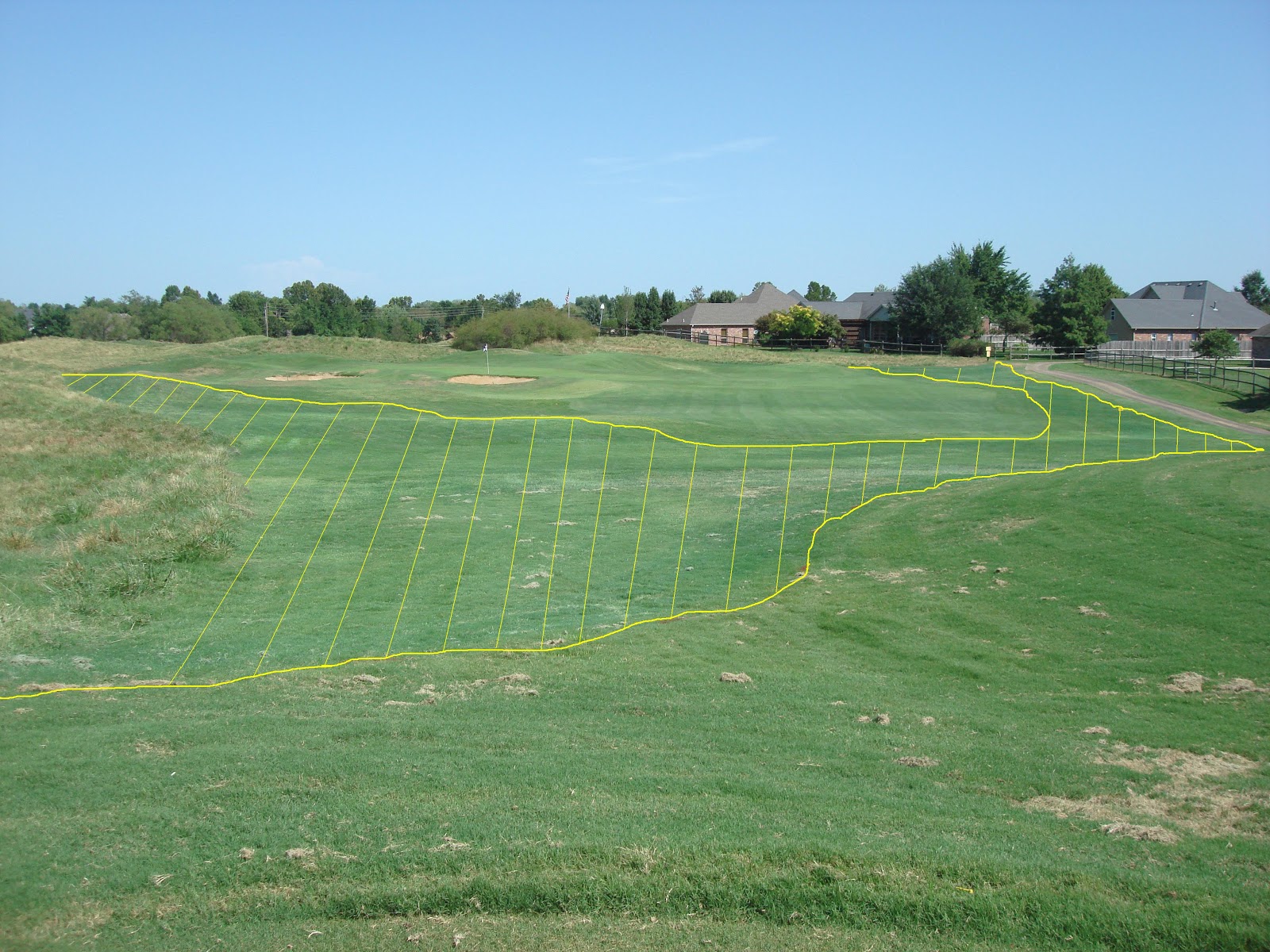
Although we are converting rough on most holes on the front nine, the biggest change will be on #8. In the picture below, you can see that we are bringing the native, that is left of the tee, around the front all the way to the cart path. The new native area will then taper up the right and left sides of the surround. This will appear more difficult, but the golfer will only have about 30 yards to carry over the new native area.

The three main goals for this plan are: to reduce operating expenses by removing 10-15 acres of maintained rough, to bring the course closer to the original design, to not increase difficulty or pace of play. To determine which areas to reestablish, we are using aerial photos from before the course was opened. These photos are helping us see the architects original design so we can bring back some of these native areas that have been lost over the years. This year we focused on the front nine because this is where we have the greatest acreage to mow.
Although we are converting rough on most holes on the front nine, the biggest change will be on #8. In the picture below, you can see that we are bringing the native, that is left of the tee, around the front all the way to the cart path. The new native area will then taper up the right and left sides of the surround. This will appear more difficult, but the golfer will only have about 30 yards to carry over the new native area.
Friday, August 12, 2011
Deep Tining Greens
Thursday, August 11, 2011
More Rain
We finally got the drought relief we have been waiting for. The heavy rain over the last two days has brought our total to over 4 inches in the last 6 days. All of our ponds are full again and the Bermuda is greening up quickly. I plan on fertilizing tees, fairways, and rough next week to encourage more growth and improve conditions course wide.
Wednesday, August 10, 2011
Rain!
After weeks of searing heat and relentless drought, Mother Nature has finally given us some rain. We got a half inch of rain over the weekend and then another quarter inch on Monday night. It seems that the tees and fairways are already starting to respond to the moisture and are starting to come out of dormancy. There are strong chances of storms this week so hopefully we will get some more rain to fill our ponds back up.
Thursday, August 4, 2011
Greens fans

The agronomy team here at Bailey Ranch recently received some new 50" diameter greens fans. Three fans were purchased for the 3 greens we typically have issues with during the summer. #1, #12, and #13 greens have air flow issues due to the amount of trees that surround these greens complexes. We have aggressively removed a majority of these problem trees but many remain on homeowner property.
These fans will push a larger column of air much farther than the older fans, which will cool the greens surface temperatures more effectively. This increase in air flow will not only reduce surface temperatures but it will also allow the greens to dry out more easily after a rain. We have already seen an average surface temperature reduction of 4-6 degrees between 12 and 2pm. This is typically when surface temperature are the hottest and this reduction keeps the growing conditions similar to the other greens on the golf course.
Drought Update


Wednesday, July 27, 2011
Irrigation leak on #17

Some of you might have seen the geyser on #17 yesterday afternoon. One of the irrigation fittings, we connect our greens hoses into, broke yesterday afternoon forcing us to close down the system to the entire back nine. Due to some quick thinking, and a lot of hard work, we resolved the issue with no negative effects to the other greens. Seeing leaks like in this photo, you can appreciate the amount of pressure required to run a system of this size.
Thursday, July 7, 2011
Effects of drought on golf course


Tuesday, June 28, 2011
Syringing Greens

Well it feels like August already and the syringe team is out in full force. Syringing is a term used to describe the application of water on Bentgrass greens during the hottest part of the day to reduce heat stress. This watering is done very lightly and multiple times a day. The agronomy staff has been trained to stay out of the way of golfers as much as possible, but there are times when we have no choice but to water in between groups. We ask that whenever you see someone watering a green in front of you, and they have pulled the flagstick, that you please give them a minute to finish before you hit your approach shot. No one likes to get hit with a golf ball and we certainly do not enjoy holding up play. We thank you for your patience and look forward to a great summer.
Monday, June 27, 2011
#1, #12, #13 Greens

I've been getting numerous questions regarding the appearance of #1, #12 and #13 greens. We sent samples to a plant pathologist at Oklahoma State University and the samples came back positive for Pythium blight. Pythium is a common disease found on stressed turf usually during intense heat and humidity. These greens receive considerably less air movement and sunlight. This means that these greens endure more intense heat, and humidity, and because of this, disease pressure is more severe on these three greens.
Once we confirmed the presence of the Pythium, the affected greens were treated with a fungicide specific to this disease and a light rate of fertilizer was applied to encourage recovery. The agronomy team has been working very hard to improve the growth conditions over the last few weeks by removing shade trees, utilizing fans to circulate more air, closely monitoring soil moisture, leaf temperature and nutrient levels. Progress may be slowed by the intense heat but we are already seeing some improvement.
If you have any further questions feel free to contact me. Thanks
#2 Green

Several people have asked me about the spots on #2 green. These spots are Annual Bluegrass under heat stress and is dying out. Annual Bluegrass, or Poa, is a common weed in Bentgrass putting greens and has been slowly establishing itself for years. Our new handwatering techniques and monitoring systems have allowed us to significantly reduce the amount of irrigation required to keep the Bentgrass healthy. Besides improving the health of the Bentgrass, this reduction in water usage is also stressing out the Poa. Poa needs more soil moisture than Bentgrass to survive the heat of the summer and since it isn't available, these plants are starting to die out. Although #2 green looks funny now, in time the Bentgrass will fill in these spots and the amount of Poa will continue to decline.
Subscribe to:
Comments (Atom)