Wednesday, November 30, 2011

#12 bunker renovation

Well after some rain delays and thanksgiving, the crew is back out working on #12 bunker.  Topsoil is being added and tamped to finish forming the back sides of each bunker.  In the photo you can see that we have begun cutting the new lip of the back bunker.  Once the bottom of the bunker is dried out, the inside of the bunker can be tamped so we can begin hand digging the new bunker drainage.


Monday, November 14, 2011

12 bunker

The next step in the renovation is the installation of the drainage.  The drainage that carries the water from the bunker drainage to the creek must be installed before the new drainage inside the bunker can be put in.  Once the pipe is laid, the trenches will be backfilled and the final shaping can be done.   


Thursday, November 10, 2011

#12 bunker renovation

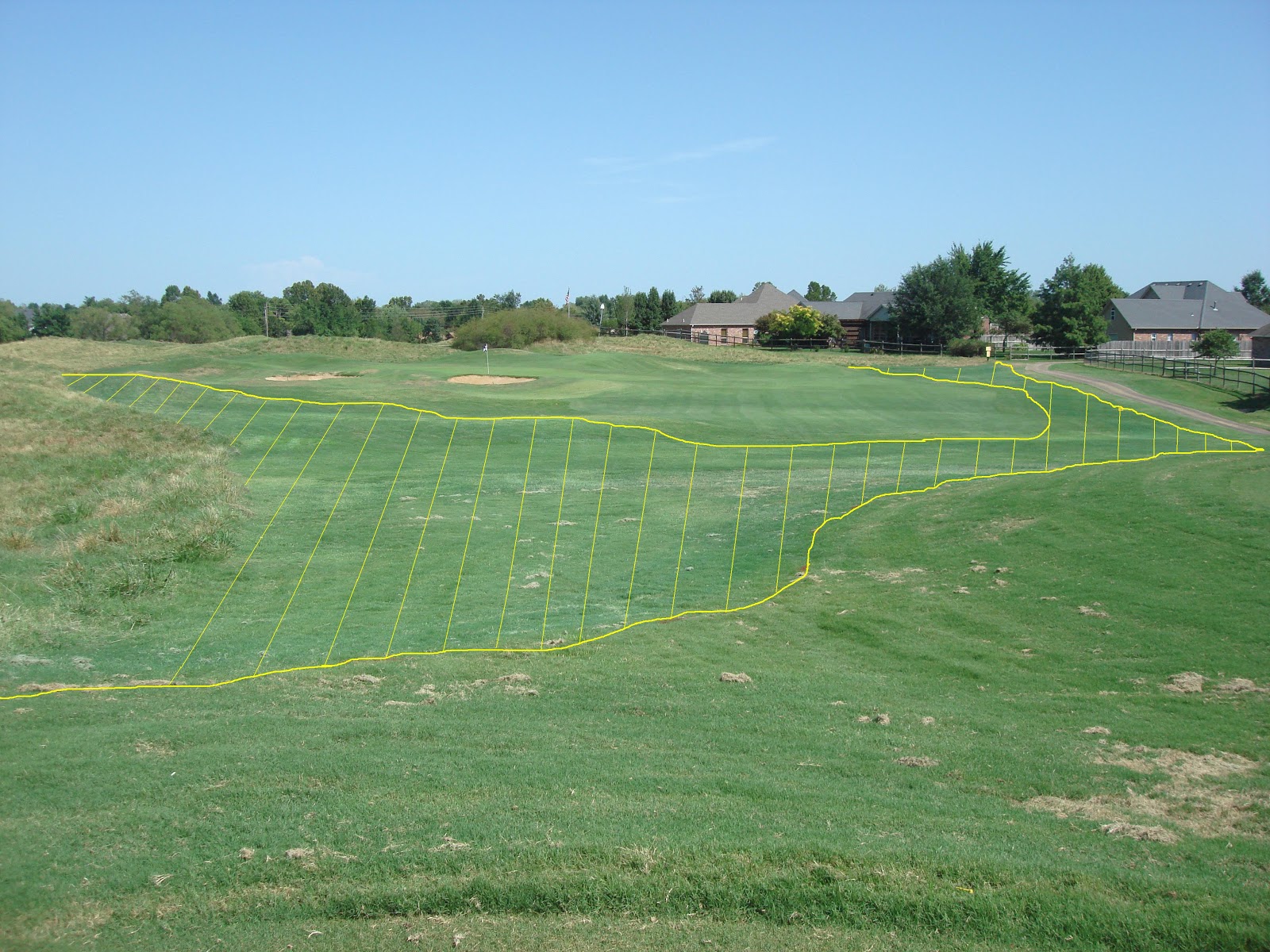
Rough grading has officially begun on the renovation on #12 greenside bunker. The new bunker shape is beginning to emerge.  Similar to the renovation on #8, the square footage is being reduced while keeping the most used portions.  The remaining bunkers are being recontoured and new drainage will be installed.  The part that is being removed will be converted to a grass basin.


Wednesday, November 9, 2011

Chipping green update

The over the last few weeks, the Chipping green has made a lot of progress.  Mild temperatures, heavy rains, and a steady diet of nutrients have really helped this green get back on track.  We will begin lowering the height and topdressing with sand while we are still under good growth conditions.


Carts on path reminder

This morning we received our first groups of play since the rain yesterday, and this is what I saw on #12. 

Please remember to follow all cart rules.  We have them to protect the course from this kind of avoidable damage.  Thank you.


Tuesday, November 8, 2011

Aftermath of rain

Whenever it rains more than an inch, the staff must go out and check drain basins and fix bunkers.  Here is a picture of the guys in action repairing the bunkers on #5 green.  As you can see, the heavy rain eroded the sand exposing the soil underneath.  Silt will wash off this exposed soil and contaminate the bunker over time.


More rain

Well, we're at 3.5 inches and counting.  Looks like we are in for some more before it moves out of the area.  With this much rain, our creeks and tunnel are flooded and we will be closed until they are passable. Today we will be busy getting the course ready for  tomorrow's play.

Monday, November 7, 2011

#2 green update

The agronomy staff has spent the last few days laying sod into the damaged areas on #2.  Today they are down to the smallest areas and should wrap up by the end of the day.  Once our sand pile dries, a heavy application of topdressing will be applied to aid in the establishment smooth the new sod.


Signs of fall

The leaves are really changing and it's looking more and more like fall.  Hopefully winter isn't in a big hurry to get here!


Rain

We came this morning and saw that the system that moved through last night dumped an inch of rain.  We are cart path only today and possibly tomorrow since more rain is expected. 


Friday, October 21, 2011

Tree removal

View from behind #1 green facing west
This week the maintenance staff has been working on removing shade trees from around the greens.  This process has been ongoing since early summer.  As the angle of the sun changes with the seasons, different trees become a problem and must be removed.  Our goal is to have sunlight on the greens as soon as possible in the morning.  A green that has access to sunlight all day is going to be much healthier than one that is shaded until mid morning.  Turf must have sunlight to create energy, so shading a green until late morning is like skipping breakfast everyday.  Also, morning sunlight allows surface moisture to begin evaporating so the green is less susceptible to disease.  Removing these shade trees, coupled with the fans that were purchased, the agronomy staff will be able to replicate the ideal growing conditions that are found on many of the other greens on the course.  This will set us up for long-term success in the future.

Wednesday, October 19, 2011

Chipping green update

It has been almost a full month since seeding and the green is beginning to take shape.  We have been aggressively fertilizing and watering the green to get the seedlings up.  Now that walk mowing has started, we will continue to push the green with fertilizer and increase our mowing frequency.  This will force the plant to grow across the surface more and fill in.  It is going to get cold during the next few days but hopefully the weather remains mild and we can encourage as much growth as possible during the next 4-6 weeks.

Temporary green on #2


As of Monday, the agronomy staff has implemented a temporary green for #2.  The end of the fairway was cut lower and topdressed to give the temporary a smoother roll.  An eight inch cup has also been used to make it more fun to play.
This green experienced extremely high levels of a plant parasite called nematodes.  These nematodes are microscopic and survive in the soil during the growing season.  They extract nutrients from the roots of healthy plants thereby compromising the turfs ability to handle severe stresses such as the intense heat and drought experienced this summer.  We decided that in order to take advantage of the prime growing conditions right now, that we would restrict play on this hole to a temporary green, to give the green a break from all the foot traffic.  This will also allow the agronomy staff more access to the green for repairs.  We are planning on re-opening this green in a couple of weeks once the green fills in and is in acceptable condition.  We apologize for the inconvenience but look forward to the improved conditions on this green.

Saturday, October 1, 2011

Chipping green renovation update

Day 1

Day 7
It's been over a week since we seeded the chipping green and the young seedlings are coming up nicely.  We have been blessed with great weather so the establishment is right on schedule.  Mowing will begin within the next week or so.  Once we are able to mow the green a few times a week, we will begin lightly topdressing the green with sand to smooth out any imperfections that may develop during establishment.

Thursday, September 22, 2011

Chipping green renovation

Now that the fall season is upon us, the weather is perfect for establishing new greens from seed.  As most of you are aware, the chipping green west of the driving range was used last fall as a nursery so we could plug fresh turf onto the golf course.  We were unable to renovate last fall due to other priorities on the golf course.  Also, we decided earlier in the season to delay reseeding until fall when the seed would have a better chance of survival.
Removal of old green
Over the last few days, the agronomy team has been working to remove the top four inches of the original green.  We also are taking the opportunity to expand the edge of the green out into the Bermuda to its original dimensions.  Years of Bermuda slowly encroaching inwards has left the green much smaller than it used to be.  Once the top four inches is removed, new greens mix is added back in to the green.  This root zone mixture is specifically blended for golf course greens and is 90% sand and 10% peat moss.  The peat moss allows the sand to retain moisture and nutrients.  After the new mix has been added, a tiller is used to blend the new sand mix with the original mix underneath.  This creates a more uniform soil profile and will improve the grasses ability to create long, healthy roots.  Once the profile has been thoroughly blended, the sand is raked, hand watered, and plate tamped.  The finished product is a smooth, firm sand surface that we can walk on without creating footprints.
Plate tamping of new profile
The last steps in the process are to fertilize, seed, then press the seed into the surface.  Seed to soil contact is crucial to the success of any establishment project.  This is accomplished with the tires of our bunker rake.  The tire tread is ideal for this because as the machine rolls across the green, little square depressions are created.  These depressions will help keep the seed moist and protect it from mower injury once we begin walk mowing.
During the next week or so, the chipping green will have a special irrigation schedule.  It will be running every few hours or so to keep the seed moist.  Once the seed germinates, we will begin to reduce the frequency and increase the amount of irrigation to promote deep rooting.
Blending root mix

Finished product before seeding

Thursday, September 8, 2011

Fall greens aeration


It's time for fall greens aeration and after the summer we've had it couldn't have come sooner! You may have noticed some hole closures this week as we work our way through the course. We appreciate everyone's patience during this process.  The first day went as planned and the second day was ahead of schedule until our greens aerator broke down. We fixed the machine today and are planning on finishing the last few holes first thing tomorrow morning without disrupting play. 

Wednesday, August 24, 2011

Rough/Native Conversion


It's been almost a week and the rough that was sprayed with herbicide is definitely starting to show signs of death.  There is great contrast right now between the areas to be converted and the remaining rough.  It isn't difficult to envision what the new native areas will look like now that the rough has turned brown.  We have one final herbicide application in these areas to ensure a thorough kill and then we will be seeding these areas in mid September.
Once we begin seeding these areas, it is crucial that golf carts stay out of these areas so that we can get the seed to come up properly.  We have created spaces within the new areas that will allow cart traffic from the cart path to the fairways without driving through the seeded areas.  The success of this project depends on your cooperation.  If you have any further questions don't hesitate to ask.  Thanks!

Drought recovery

#14 Aug. 10th  

What a difference two weeks and 5 inches of rain can make!  After suffering through one of the worst droughts in recent memory, we finally got some much needed rain a few weeks ago.  Since then the tees, fairways, surrounds and rough have all made a full recovery.  We fertilized the entire golf course yesterday to help continue the improved conditions.  The ability of the Bermuda to quickly recover from the drought has left the golf course is great condition for the upcoming fall tournament season.


#11 Aug. 23rd.

Saturday, August 20, 2011

Website comments

I've been posting information on this website for over a year and still have very little envolvement from those that actively read the information that is posted.  I want everyone to know that I welcome any comments and encourage those with ideas for new topics to share them.  Thank you for your interest in Bailey Ranch Golf Club and hope to see you on the course!

Friday, August 19, 2011

Rough/Native Conversion

Yesterday, we began the first phase of a plan to convert some key areas of maintained rough into native areas.  Two herbicide applications will be made this month to kill the existing rough, then we will slit-seed into these areas mid-September.
The three main goals for this plan are: to reduce operating expenses by removing 10-15 acres of maintained rough, to bring the course closer to the original design, to not increase difficulty or pace of play.    To determine which areas to reestablish, we are using aerial photos from before the course was opened.  These photos are helping us see the architects original design so we can bring back some of these native areas that have been lost over the years.  This year we focused on the front nine because this is where we have the greatest acreage to mow.
Although we are converting rough on most holes on the front nine, the biggest change will be on #8.  In the picture below, you can see that we are bringing the native, that is left of the tee, around the front all the way to the cart path.  The new native area will then taper up the right and left sides of the surround.  This will appear more difficult, but the golfer will only have about 30 yards to carry over the new native area.