.jpg)
Wednesday, January 8, 2014
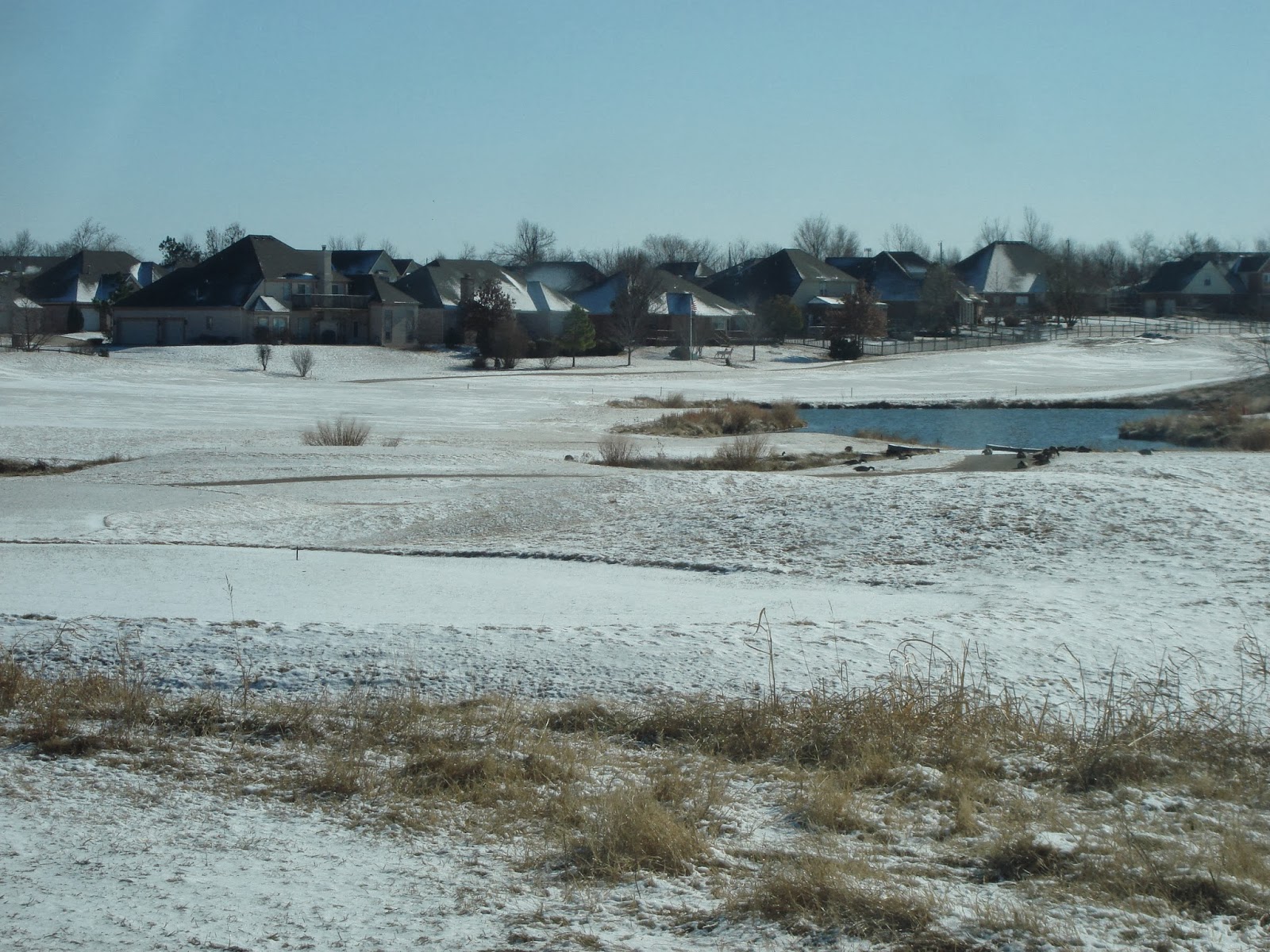
Course Update


Monday, December 23, 2013
2013 Ice Storm Update
 |
| pine trees at #9 |
 |
| Elm trees West of #18 green |
 |
| Hackberry in #14 fairway |
 |
| View of #12 green from cart path |
Monday, November 11, 2013
Winter Cart Traffic
 Managing cart traffic during wet weather is a year-round task but it becomes especially important this time of year. Lower evaporation rates and reduced usage by the dormant turf prolongs the time it takes for excess water leave the soil. This means that after a rain, the ground stays wet for much longer than expected. Last week we received almost 2 inches of rain on Tuesday. During the summer we would have likely been back off the paths the next day, however, last week, the grounds department made the decision to keep carts on paths through Thursday. We had several golfers take their carts off paths and the tracks they created are still visible. The picture on the right is front left of #11 green. There are places all over the golf course that look like this. We ask for your cooperation when we are supposed to be on paths so that mud tracks like these can be prevented. The grounds department assesses the course conditions
every day and will make changes to the cart policy as needed. Thank you.
Tuesday, October 15, 2013
Fall Greens Deep Tine Aeration
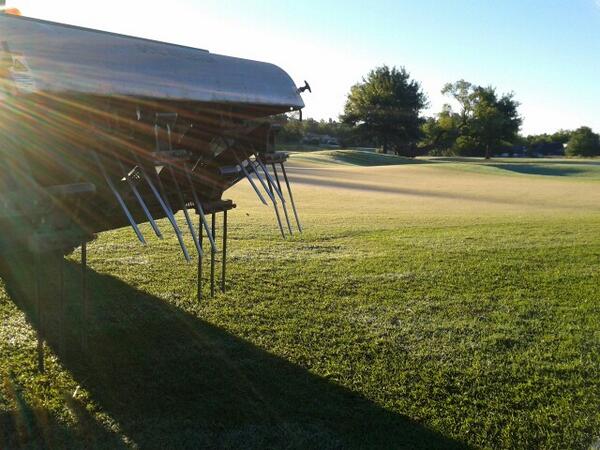
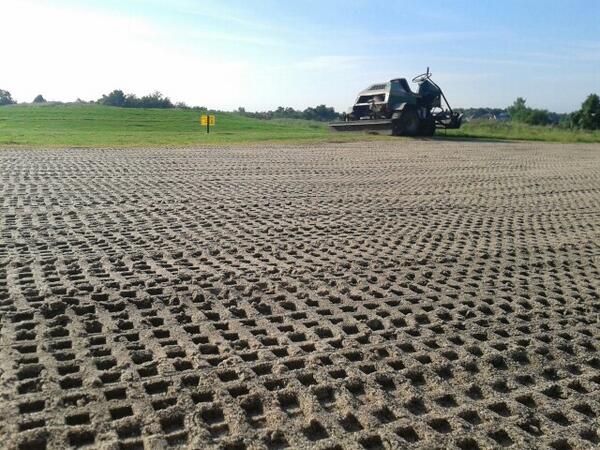
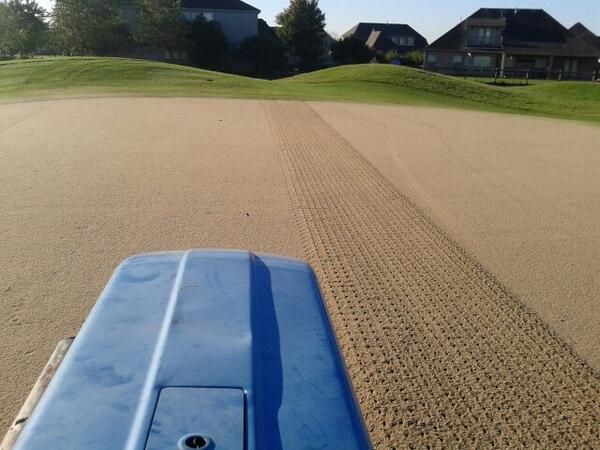 Last week, the grounds staff began deep-tining greens. The front nine greens and the practice facility were completed last week, leaving the back nine greens to be completed this week. A solid, 1/2" by 10" tine is used for this process to create deep channels filled with sand to promote long, healthy roots going into late fall. This time of year, as the days get shorter and the weather gets colder, the Bentgrass begins spending less of it's energy growing leaves and more of it's energy creating roots. We want to take advantage of this process by allowing clear pathways for those roots to grow. These holes, once created, are carefully filled with sand to ensure optimum water movement from the surface down to the drainage pipe underneath the root zone.
 Monday, September 30, 2013
Fall Course Update

As summer fades away, and the sure signs of fall are all around us, now is the best time to be on the golf course. The weather lately has been absolutely perfect. This past weekend, the golf course finally received some much needed rainfall. A storm rolled in mid-day Saturday and dropped 2 inches of rain over 4 hours. That's 4.3 million gallons over the entire golf course. Plenty of water to replenish soil moisture and refill our ponds.
Assessing the course this morning, I feel like the course is positioned nicely for fall. Our Bentgrass greens are enjoying this weather and playing conditions very good right now. The quality of our tees, fairways and surrounds will improve as well due to increased soil moisture, warm afternoons, and plenty of sunshine. I like this time of year on our Bermuda playing surfaces because they healthy and green, but the growth is slowed down due to the cooler nights. These night time lows in the 50's acts like a natural growth regulator. We are currently mowing all Bermuda once per week, down from three times a week for tees, collars and surrounds. This frees up precious labor to tackle other details that had been postponed.
It's been two weeks since greens were aerated and I am pleased with the recovery so far. The holes have filled in and the surface is smooth. Now that the sand is completely worked into the canopy, the grounds staff has begun lowering the height of cut down from our summer height of .150" to .120". Currently we are .130". We lower the height .005" after every third mowing to ensure that the turf doesn't get scalped during this process. Greens will be verticut and dusted with topdressing sand, this week, to continue to smooth and firm the surface.
As always, if you have any questions or comments, don't hesitate to contact me at 918-272-1175 or email me at ccook@cityofowasso.com
Friday, September 20, 2013
Fall Core Aeration on Greens

This week, staff completed the fall core aeration on all putting greens. We originally planned to initiate this project the day after Labor Day, but the weather proved to be too hot, so it was postponed to September 9th & 10th. Summer was stubbornly hanging around and forced us to postpone aeration yet again to this past Monday. Despite a few showers, the front nine was completely finished by Monday evening. Tuesday was a different story. The staff was able to verticut, mow, aerate and clean up the cores, but due to steady rain, no sand was applied. Wednesday morning, after the storm passed, the crew went out and began topdressing and brushing the sand into the holes.
I've written extensively, in previous posts, about the benefits of core aeration, and the process we use, so I won't go into great detail here. For those of you who are interested, I've included a link to a previous post on core aeration here.
Although core aeration of putting greens in an inherently disruptive process, the grounds staff works very hard to ensure that putting conditions return to normal as quickly as possible. The weather has been favorable and it looks like we are on track to heal in from the process in another 3-4 days.
As always, if you have any questions about the process of aeration, or benefits from aerating, feel free to ask. Thank you for your patience during this time.
Tuesday, September 10, 2013
#1 Tee Putting Green
Those of you that have played recently may have noticed some construction work taking place behind the first tee box. This work is to renovate a small putting green. A few years ago, the sod was needed to make repairs to some areas on the golf course and was never repaired. During the demolition phase, I discovered that a 2-3 feet of the original green had been encroached by Bermuda so we took the opportunity to enlarge the green to its original dimensions. In the end, we added back approximately 400 square feet to the green. This will allow us more room for hole locations.
Over the past few weeks, staff removed the old greens mix and prepped the new mix for seeding. This morning the putting green was seeded with an improved Bentgrass variety called "Tyee." This newer variety is the same as the Chipping green as well as #'s 12-14. We like this new variety due to it's improved density, drought tolerance and disease resistance. Seeding the new green today should allow for some quick germination. By Monday, we should start to see some light green "peach fuzz" developing. Once we get all the seedlings up, we need to be very careful to keep it moist and apply timely fertilizer applications to allow the turf to fill in rapidly. We hope to have our first mowing in 2-3 weeks.
I will ask that as this green begins to fill in, golfers resist the temptation to putt on it so the turf has every chance to fill in by winter. We plan on officially opening this green sometime in the spring.
If you have any questions about the process just let me know. Thanks
Tuesday, August 27, 2013
Less is More
 |
| Greens roller improves playability while reducing turf stress |
No matter what part of the country you live in, summer brings many challenges when trying to maintain Bentgrass putting greens. Heat, drought, excess rainfall, disease, foot traffic, and insects all conspire against the turf and has it fighting for it's life. We, the agronomy department, must do our part and carefully help the plant by giving it just what it needs, at just the right times. Solid tine aeration, timely fertilizer and pesticide applications, hand watering, and routine light applications of topdressing all help keep the turf healthy and ready to deal with the stresses of summer. Some other practices we utilize during the intense summer heat include: raising the height of cut, using smooth rollers, instead of grooved, on the cutting units, rolling greens instead of mowing, and using greens fans to improve air flow.
 |
| Light apps of sand dilute thatch, smooth and firm surface |
All of these practices are meant to lessen the amount of stress the plant is forced to endure. Once more seasonal weather sets in, the agronomy staff will make further adjustments and the practices employed will favor improving playability and not just survival.
 |
| Greens fans improve air flow |
 |
| Syringing allows staff to carefully manage soil moisture |
Friday, August 23, 2013
Course Update
 |
| Looking back toward #3 tee box |
 |
| #12 fairway looking toward green |
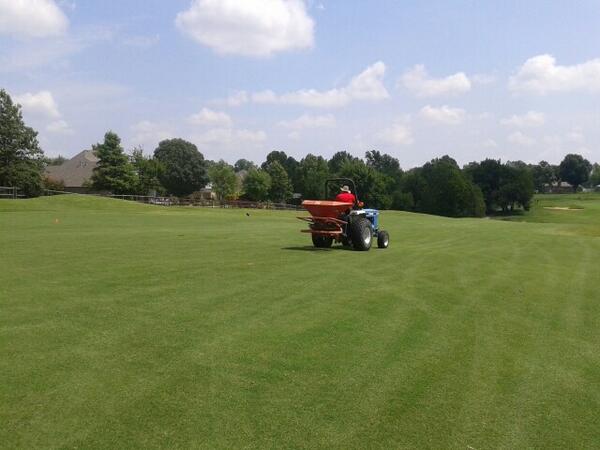 |
| Pre-emergent going down on #1 fairway |
Once Labor Day weekend passes, the agronomy staff will begin Fall greens aeration. We always schedule this Fall aeration the Tuesday and Wednesday following Labor Day so that playing conditions are not affected during the busy holiday weekend. As that project gets started, I will be providing more information walking through each step and benefits we will see from the process. For those who are curious, I've covered greens aeration at great detail in an earlier post that I've linked here.
 |
| Hand watering #18 green |
As always, if you have any questions, or comments, feel free to contact me. Hope to see you out there!
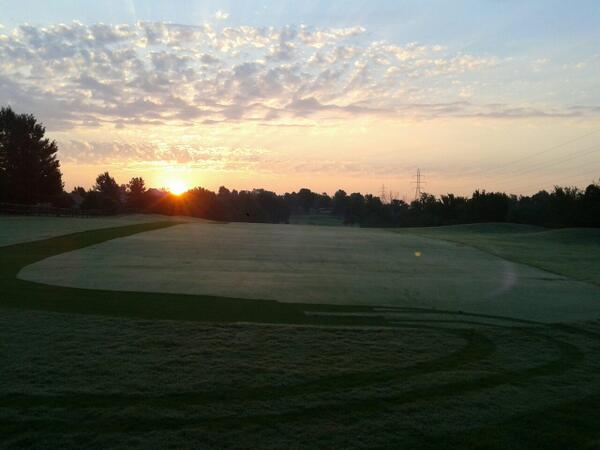 |
| Sunrise from #1 tee box |
Tuesday, August 20, 2013
USGA Article On Greens Speed & Its Effect on Turf Quality
An article recently published by the USGA Agronomy Department details the history of using the Stimpmeter to measure putting greens and how it was originally developed for superintendent to provide consistency from green to green and not intended to measure speed. The article further explains the trend in increased greens speeds and it's negative impact on turf health, usable hole locations, and pace of play. Although the article is four pages, it's well worth the read. Enjoy!
gsr.lib.msu.edu/article/soller-putting-8-9-13.pdf
gsr.lib.msu.edu/article/soller-putting-8-9-13.pdf
Thursday, August 8, 2013
Driving Range Divots

I've posted about this topic previously and the link can be found here detailing the preferred divot pattern. With your help, this tee box will recover faster and be a better quality hitting surface for all to enjoy. As always if you have any questions, please feel free to ask.
Wednesday, August 7, 2013
Golf Course Update
 |
| #4 White Tee |
From mid-June to mid-July, the golf course only received .7" of rain and began to get very dry. Over the past three weeks, we've received over 6.5" of rain and the course has responded nicely. The tees, fairways, rough and surrounds have greened up and are looking great. Lately it's been a challenge to keep up with the growth and keep it cut. The greens have held up especially well. The lack of extreme temperatures has kept the roots longer than usual and turf density has been very good.
The golf course just recently hosted it's Club Championship this past weekend and numerous members came up to staff and gave us a lot of positive feedback regarding course conditions. Membership satisfaction is the goal and the staff greatly appreciated hearing all the compliments.
The outlook for the remainder of the season looks very good. August is predicted to be cooler and wetter than average. If the weather pattern continues to hold, we expect to have excellent course conditions for the upcoming fall tournament season.
Enjoy the rest of the 2013 golf season!
 |
| #12 Fairway |
Thursday, August 1, 2013
#14 Cart Path Creek Crossing
 Today the staff put the finishing touches on the new cart path drainage structure on #14. This new creek crossing has already been tested with some heavy rain events over the past few weeks and has performed as expected. Now that the new sod has been laid, the slopes will become more stable and the new structure should last for many years to come.
 This project has been a little slow to complete, but I have to thank the Public Works Department for their willingness to assist us with the design and construction of this new cart path. We, the agronomy department, had the easy part, and just had to finish grade and lay the sod.
As with any new sod project, we ask that members and guests please use caution when traveling through this area not to drive on the new sod until it has been established. Thank you.

Friday, July 26, 2013
Edging Sprinkler Heads
 |
| Before edging |
Golf courses all have routine maintenance work that must be completed. Whether it's mowing greens, raking bunkers, topdressing, edging curbs, etc., course superintendents balance there weekly routine with miscellaneous items that must be addressed. Although sometimes difficult to get to, tending to the details is what can take a golf course to the next level. Edging sprinkler heads is one of these detail items that is fairly involved and we don't seem to be able to get to it as often as we'd like. This week, due to milder weather and a lack of hand watering greens, we've committed to completing this project.
When eding sprinkler heads, the crew takes the project hole by hole, locating the heads and then marking them with wire flags. Once they are marked, a weed-eater with a special attachment is used to edge the sprinkler head. Lastly a blower is used to clean off the head and pull the flag to indicate it is finished. By the time the crew finishes today, they will have edged over 750 sprinkler heads on the golf course.
This edging has several benefits, it cleans up the head and makes the yardages on the lid more visible. Edging also allows the head to function properly by keeping the Bermuda from growing down inside the head.
 |
| After edging |
Saturday, July 20, 2013
Plum Hollow Greens Department: Beating the Heat
Here is a fantastic video created by Adam Garr, superintendent at Plum Hollow Country Club. Although this video was shot in Pennsylvania, the concepts and practices employed, are utilized here as well.
Plum Hollow Greens Department: Beating the Heat
Plum Hollow Greens Department: Beating the Heat
Monday, July 1, 2013
Greens Syringing

Tuesday, June 18, 2013
Venting Greens

This morning the agronomy staff is venting greens with bayonet tines on our new walking greens aerator. These knife-like tines create a small slit in the surface but create a hole 3.5" deep. As mentioned in the video, this process has several great benefits: improves water infiltration, increases soil oxygen content, releases CO2 trapped in the root zone, allows for the upper 3-4 inches of the profile to dry more consistently, creating a firmer putting surface. Healthy roots equate to a healthy turf, which will be better suited to handle the harsh conditions of our Oklahoma summers. This process will be repeated every two weeks until the weather cools off in the fall.
Tuesday, June 11, 2013
#8 Native Area
 |
| #8 before the conversion |
 |
| #8 after the conversion |
Wednesday, June 5, 2013
Tee aeration
 |
| #6 tee |
Wednesday, May 29, 2013
Slicing Fairways
 |
| Slicing #1 fairway |
 |
| Mowing #11 Fairway |
Subscribe to:
Posts (Atom)