Tuesday, August 27, 2013

Less is More


Greens roller improves playability while reducing turf stress
A recent blog post by fellow superintendent Chris Tritabaugh at Hazeltine National Golf Club, had me thinking about our own strategies for Bentgrass survival.  I've included a link to his blog here.  I believe his main point in that post was that in order to provide the best conditions year round, sometimes less is more.  Meaning give the turf a break so that we don't compound the stresses that the turf is already dealing with.

No matter what part of the country you live in, summer brings many challenges when trying to maintain Bentgrass putting greens.  Heat, drought, excess rainfall, disease, foot traffic, and insects all conspire against the turf and has it fighting for it's life.  We, the agronomy department,  must do our part and carefully help the plant by giving it just what it needs, at just the right times.  Solid tine aeration, timely fertilizer and pesticide applications, hand watering, and routine light applications of topdressing all help keep the turf healthy and ready to deal with the stresses of summer.  Some other practices we utilize during the intense summer heat include: raising the height of cut, using smooth rollers, instead of grooved, on the cutting units, rolling greens instead of mowing, and using greens fans to improve air flow.
Light apps of sand dilute thatch, smooth and firm surface

All of these practices are meant to lessen the amount of stress the plant is forced to endure.  Once more seasonal weather sets in, the agronomy staff will make further adjustments and the practices employed will favor improving playability and not just survival.  

Greens fans improve air flow


Syringing allows staff to carefully manage soil moisture

Friday, August 23, 2013

Course Update

Looking back toward #3 tee box
#12 fairway looking toward green
Summer is slowly winding down and most of our seasonal staff have gone back to school.  Those that remain are working hard to keep the course in the best condition possible.  The cooler, rainy weather has passed and the weather pattern is getting somewhat back to normal.  With highs in the mid 90s, ample soil moisture, and plenty of sunshine, the turf is very happy.  These excellent growing conditions are reflected by the improved playing surfaces.  Turf density, and color have improved considerably over the past month.


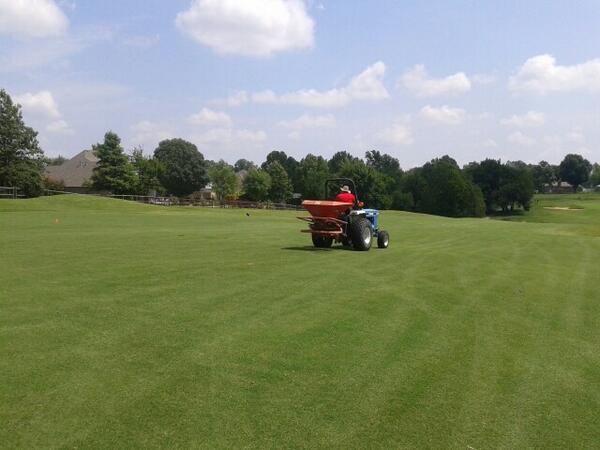
Pre-emergent going down on #1 fairway
One big project the agronomy staff completed this week was applying our fall pre-emergent herbicide to tees, fairways, approaches and rough.  Mid-August to mid-September is the ideal time to apply fall weed control products.  The rest of our week consisted of morning course setup, mowing and watering greens.  The staff has done a great job keeping quality playing conditions and I am very pleased with where we are at this point in the season.

Once Labor Day weekend passes, the agronomy staff will begin Fall greens aeration.  We always schedule this Fall aeration the Tuesday and Wednesday following Labor Day so that playing conditions are not affected during the busy holiday weekend.  As that project gets started, I will be providing more information walking through each step and benefits we will see from the process.  For those who are curious, I've covered greens aeration at great detail in an earlier post that I've linked here.

Hand watering #18 green
Looking ahead at the Fall weather forecast, I feel that the golf course is primed for a fantastic finish to a successful golf season.
 
As always, if you have any questions, or comments, feel free to contact me.  Hope to see you out there!  


Embedded image permalink
Sunrise from #1 tee box


Tuesday, August 20, 2013

USGA Article On Greens Speed & Its Effect on Turf Quality

An article recently published by the USGA Agronomy Department details the history of using the Stimpmeter to measure putting greens and how it was originally developed for superintendent to provide consistency from green to green and not intended to measure speed.  The article further explains the trend in increased greens speeds and it's negative impact on turf health, usable hole locations, and pace of play.  Although the article is four pages, it's well worth the read.  Enjoy!

gsr.lib.msu.edu/article/soller-putting-8-9-13.pdf

Thursday, August 8, 2013

Driving Range Divots

Since the driving range tee gets constant use, allowing portions of the tee box to fully recover before it is needed again is of the utmost importance.  The best way for golfers to ensure the quickest recovery possible, is to use proper technique when practicing.  By using the turf on the back edge of the previous divot, players are able to impact a much smaller area that if they scatter there divots.  The picture on the right is someone using the worst possible divot pattern.  This area is almost 2 sq. ft. and will take weeks to fully recover.  

I've posted about this topic previously and the link can be found here detailing the preferred divot pattern.  With your help, this tee box will recover faster and be a better quality hitting surface for all to enjoy.  As always if you have any questions, please feel free to ask.       

Wednesday, August 7, 2013

Golf Course Update

#4 White Tee
I've mentioned several times on Twitter the stark differences in the weather this year compared to the last few years.  The average monthly high temperatures have been about 12-15 degrees cooler.  We haven't seen a mild summer like this since 2009.  

From mid-June to mid-July, the golf course only received .7" of rain and began to get very dry.  Over the past three weeks, we've received over 6.5" of rain and the course has responded nicely.  The tees, fairways, rough and surrounds have greened up and are looking great.  Lately it's been a challenge to keep up with the growth and keep it cut.  The greens have held up especially well.  The lack of extreme temperatures has kept the roots longer than usual and turf density has been very good.

The golf course just recently hosted it's Club Championship this past weekend and numerous members came up to staff and gave us a lot of positive feedback regarding course conditions.  Membership satisfaction is the goal and the staff greatly appreciated hearing all the compliments.

The outlook for the remainder of the season looks very good.  August is predicted to be cooler and wetter than average.  If the weather pattern continues to hold, we expect to have excellent course conditions for the upcoming fall tournament season.

Enjoy the rest of the 2013 golf season!  

#12 Fairway


Thursday, August 1, 2013

#14 Cart Path Creek Crossing

Today the staff put the finishing touches on the new cart path drainage structure on #14.  This new creek crossing has already been tested with some heavy rain events over the past few weeks and has performed as expected.  Now that the new sod has been laid, the slopes will become more stable and the new structure should last for many years to come.

This project has been a little slow to complete, but I have to thank the Public Works Department for their willingness to assist us with the design and construction of this new cart path.  We, the agronomy department, had the easy part, and just had to finish grade and lay the sod.

As with any new sod project, we ask that members and guests please use caution when traveling through this area not to drive on the new sod until it has been established.  Thank you.

Friday, July 26, 2013

Edging Sprinkler Heads

Before edging
Golf courses all have routine maintenance work that must be completed.  Whether it's mowing greens, raking bunkers, topdressing, edging curbs, etc., course superintendents balance there weekly routine with miscellaneous items that must be addressed.  Although sometimes difficult to get to, tending to the details is what can take a golf course to the next level.  Edging sprinkler heads is one of these detail items that is fairly involved and we don't seem to be able to get to it as often as we'd like.  This week, due to milder weather and a lack of hand watering greens, we've committed to completing this project.
 
When eding sprinkler heads, the crew takes the project hole by hole, locating the heads and then marking them with wire flags.  Once they are marked, a weed-eater with a special attachment is used to edge the sprinkler head.  Lastly a blower is used to clean off the head and pull the flag to indicate it is finished.  By the time the crew finishes today, they will have edged over 750 sprinkler heads on the golf course.

This edging has several benefits, it cleans up the head and makes the yardages on the lid more visible.  Edging also allows the head to function properly by keeping the Bermuda from growing down inside the head.

After edging
 

Saturday, July 20, 2013

Plum Hollow Greens Department: Beating the Heat

Here is a fantastic video created by Adam Garr, superintendent at Plum Hollow Country Club.  Although this video was shot in Pennsylvania, the concepts and practices employed, are utilized here as well.
  
Plum Hollow Greens Department: Beating the Heat

Monday, July 1, 2013

Greens Syringing


The greens syringe team has been out each afternoon for the past few weeks and we've had several incidents of people hitting into them while they are cooling off the greens.  Our main focus during the afternoon is to keep the greens cooled off and the staff works diligently to keep out of the way of play.  However, there are times when holding up play is unavoidable.  When the employee pulls the flagstick out of the cup, we'd please ask that golfers just give us a few moments to get the green watered.  Once the flag is put back in the cup, play can resume.  We realize that it can frustrating to have to wait, but appreciate your patience during this time of year.


Tuesday, June 18, 2013

Venting Greens


This morning the agronomy staff is venting greens with bayonet tines on our new walking greens aerator.  These knife-like tines create a small slit in the surface but create a hole 3.5" deep.  As mentioned in the video, this process has several great benefits: improves water infiltration, increases soil oxygen content, releases CO2 trapped in the root zone, allows for the upper 3-4 inches of the profile to dry more consistently, creating a firmer putting surface.  Healthy roots equate to a healthy turf, which will be better suited to handle the harsh conditions of our Oklahoma summers.  This process will be repeated every two weeks until the weather cools off in the fall.

Tuesday, June 11, 2013

#8 Native Area

#8 before the conversion
I was digging around in some old photos earlier and I came across a photo of #8 before the native conversion and it caught my eye.  The new native area on #8 has been established for long enough now that I'd forgotten what it used to look like.  I think that bringing the native area around to the front of the tee boxes adds more character to the hole, as well as some intimidation to an otherwise short par 3.


#8 after the conversion

Wednesday, June 5, 2013

Tee aeration

#6 tee 
Yesterday the agronomy staff began core aeration of the front nine tee boxes.  This process uses our Soil Reliever aerator with 3/4" hollow tines.  Once the aerator is finished with a tee box, the cores are left to dry for a few minutes before the metal drag mat is used to break them up.  Breaking up the cores separates the soil from the thatch so it can be reincorporated into the canopy.  Then the tee box is blown off and mowed.  All the front nine tee boxes were completed yesterday.  The remaining tee boxes will be finished on next Tuesday when we are closed.  We appreciate everyone's patience during this time.


Wednesday, May 29, 2013

Slicing Fairways

Slicing #1 fairway
With a busy Memorial Day weekend behind us and with prime growing conditions for the Bermuda, the agronomy staff is out this week slicing fairways.  The machine we use for this process is called an Aerway Shattertine aerator.  The great aspect of using this type of machine, is that although it leaves a small slit at the surface, it has a much bigger impact in the soil.  The tines are curved which causes the soil to be pushed to one side, fracturing it as they come back out.  This "shattering" effect has several benefits, reducing the compaction that has built up and allowing improved drainage and oxygen content in the soil.  All of these improvements will result in a better root zone and healthier turf.  Staff will be out mowing and blowing fairways later this week in an effort to further clean things up for the weekend.  


Mowing #11 Fairway


Thursday, April 25, 2013

Bermuda Encroachment in Greens

Chalky residue from Tupersan application
Each season, we enter into a power struggle between the warm-season Bermudagrass collars and the cool-season Bentgrass putting greens.  The lateral growth habit, and aggressive nature, of Bermudagrass during the summer is at odds with the Bentgrass just trying to survive.  This can cause
Slot created from edger
the Bermudagrass to creep into the greens, therefore reducing the size of the greens over time.  Allowing greens to shrink has several negative impacts: more difficult to hit with an approach shot, reduction in pin locations, and foot traffic is concentrated within a smaller area which will affect turf quality.

At the start of spring, when the collars begin to green up, we use two popular methods to prevent this encroachment from occurring.  First, we spray a pre-emergent product called Tupersan.  This herbicide has the ability to prevent the Bermudagrass from rooting into the green with no negative effects to the underlying Bentgrass.  Doug, our chemical technician, applies this product along the edge of the green every 4 weeks throughout the growing season.  The second method we use is weekly edging of the green.  A walk-behind edger is used to cut down approximately two inches into the soil to sever the Bermudagrass stolons that are creeping into the greens edge.  This weekly process will continue until the Bermudagrass goes dormant again this fall.        

Thursday, April 4, 2013

Building a Base

Putting green 4.5" root depth
In harsh environments, the ultimate success and sustainability of any putting surface is the ability to maintain deep, dense roots.  The greens here at Bailey Ranch are Creeping Bentgrass which is a cool-season turf that can tends to grow in cooler, more temperate northern regions.  It can, however, tolerate periods intense heat and drought if the plant has sufficient root mass to gather water and nutrients.  For turf managers in the "transition zone", the goal each spring and fall is to grow roots as deeply as possible so there is a better chance to survive whatever harsh conditions the next summer will bring.
Chipping green 7.5" root depth
Root depths are monitored throughout the year and this morning I went around and selected 4-6 greens to audit.  I was pleased to have such a good starting point to work off of since we are now phasing out of winter and into our busy spring growing season.  As I went around, I did notice a big disparity between the original greens (PG,#9,#17, etc..) and the recently renovated chipping green.  I took pictures of the root depths of the putting green and chipping green and you can see from the pictures to the right, that there is a striking difference in depth.
Since putting green soil is comprised of mostly sand, roots must be present for the sand to hold together.  This allows for a good visual indicator of rooting depth and density.  If you look at the pictures to the right you'll see a darker, almost layered composition of the putting green soil profile versus a lighter, more consistent soil profile in the chipping green.  This difference is due to a renovation that was completed on the chipping green in the fall of 2011.  The putting green has 20 years of organic matter built up in it.  You'll notice the cylindrical shaped root mass sticking out of the bottom of the putting green plug.  This is a core aeration hole, confirming the benefits of the process.  The agronomy staff plans to continue an aggressive greens maintenance schedule in order to bring the soil profiles on these older greens up to standard.  Our goal is to have all the greens at the depths you see to the right.
If you have any questions regarding greens maintenance, don't hesitate to ask.  Thanks!

Monday, April 1, 2013

New Flag Design

A new flag design was unveiled today. The checkered flag design has been replaced with a plain white flag with a black border.  The idea to change the design was born from some issues that were realized while using the checkered flags.  The old flags were much heavier which caused the flag sticks to lean and bend under windy conditions.  The old flags were also expensive and difficult to see at a distance.
The new,simplified look accomplishes several objectives.  First, they are much lighter and will not wear out the flag sticks, and cups, as fast.  Second, less fabric allows the flag to accurately display softer wind conditions, and direction, during your approach shot.  Finally, due to less fabric and stitching, they are much more cost effective to replace.  We sincerely hope you enjoy the new course accessories!

Thursday, March 28, 2013

#14 Cart Path Project


It's hard to miss the cart path work near #14 forward tees that began this week.  As of today the creek crossing is completely gone and carts are being diverted to the east.
For years, the cart path has been slowly falling a part due to erosion from heavy rains.  Wednesday the Public Works department began demolishing the old creek crossing to make way for the new structure.  You'll notice quite a bit of additional dirt work being done to both the upstream and downstream side where the channel is being straightened and widened to make room for the new drainage structure.  The original pipe was 18", this new crossing will have two 24" pipes and wing walls to help guide the water through the pipe.
Once the new pipe is laid into place, the structure
will be back filled and new cart paths installed.  Finish grading and sod will be the last steps.  Weather depending, we hope to have this project completed by the end of next week.  Cart access will be maintained at all times and we appreciate everyone's patience during the remainder of the project.

Wednesday, March 20, 2013

March Greens Aeration

Despite the cool, sometimes cloudy, conditions over the past few days, the agronomy staff worked diligently to complete the March greens aeration on schedule.  Over the years, I've detailed the core aeration process on this blog, so I won't go into too much detail but the following pictures should shed some light on a few of the major steps required.  As with all core aerations, the sand-filled holes will be evident for about 7-10 days before they completely heal in.  During this time, the agronomy staff will be mowing and rolling the greens to maintain the highest quality putting surfaces possible.  We thank you for your patience and understanding during this time.  If you have any further questions, feel free to contact me.


Soil cores are removed from greens
Cores are pushed to the collar and removed
Once cores are cleaned off, USGA topdressing sand is applied
After sand is incorporated into holes, excess sand is blown off greens
Green is then rolled smooth and watered in


Grass Fire Danger


After an incident that occured on #1 fairway yesterday afternoon, I thought I would take an opportunity to remind all members and guests that while the Bermuda is dormant, there continues to be a high risk of grass fire.  The agronomy staff would ask that caution be used when disposing of cigarettes and cigars on the golf course.  The picture to the right shows how quickly fire can spread.  Thankfully the staff reacted quickly and was able to use the irrigation system to extinguish the fire.

Friday, March 15, 2013

Cart Path Repair

Removing old cart path
Starting last Thursday March 14th, staff began the process of repairing a section of cart path near #12 tee complex.  Anyone who has played golf out here recently knows this area was in need of attention and we are pleased to be able to get this fixed before the busy golf season starts.  The old cart path was removed with a mini-excavator and the soil beneath was leveled.  Once we had the area graded, we installed the wood forms and the gravel base.  Today, the new concrete was installed and finish textured with a soft broom.  This area should be ready for cart traffic in a few days.  The area has been marked to divert cart traffic around the area to the west.  We would appreciate everyone take caution through this area.  Next week, staff will remove the forms, backfill soil along the edges, and install sod.  


Cart path ready for concrete
New cart path poured and finished