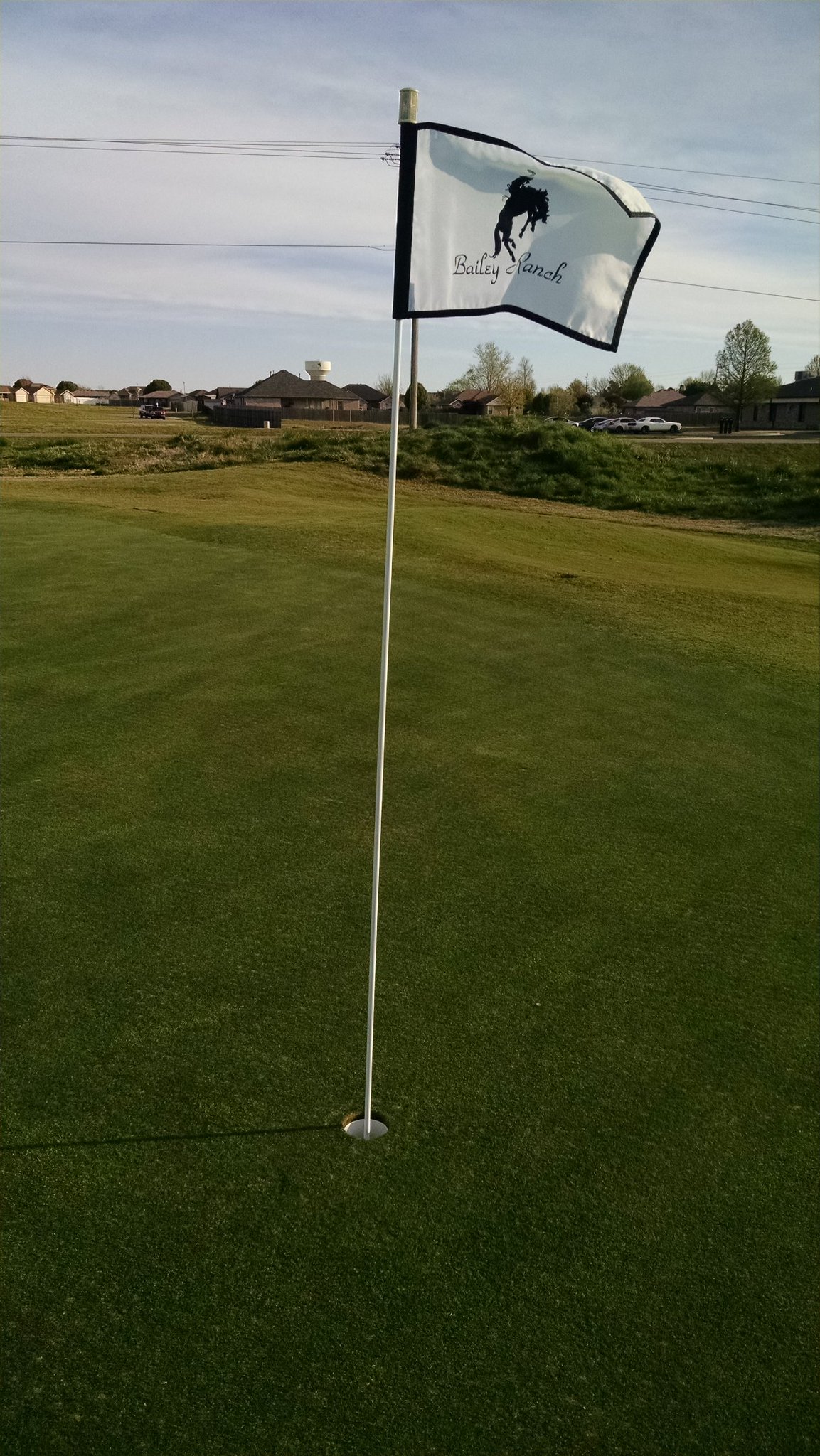
Tuesday, August 23, 2016

#3 Pond Dam Construction Project


Yesterday, was the first day of the pond dam reconstruction project on #3.  The earthen dam between the middle pond and lower pond at #3 washed out several years ago.  Early on during the planning phase of this project we discussed not just replacing the dam with clay, but installing a concrete weir with native rocks so this hole would have a water feature.  Design plans were created and the necessary funds were included in this years budget.  The project kicked off yesterday and is expected to last up to 90 days depending on the weather.

While the contractors are working on this project, hole #3 will play as a temporary par 3.  The tees have been moved to the fairway to ensure the safety of the construction workers while they are on site.  The picture on the right shows the signage located at the tee complex.  The aerial photograph pictured below depicts the general location of the work site relative to the in-play areas in the vicinity.  Please note that in order for the project to be completed on schedule, the contractor will be working while golfers are in the area.  We appreciate your patience and understanding while we work to complete this project.


Monday, August 15, 2016

Fall is Coming!


This past weekend brought us some much needed relief from the recent high temperatures and intense humidity that we experienced for the last month or so.  It appears that this cooler weather may stick around until the end of August.  Usually after Labor Day weekend, the daily high temperature falls down into the 80s and continues to cool off through fall.  This could mean that we are done with the extreme heat of summer… hopefully.

The cool-season Bentgrass on our greens enjoys the cooler weather just as much as we do.  When the soil temperature cools down into the 60s, new roots are initiated and the plant begins to rebuild the root system.  As a more vigorous root system is reestablished, the turf requires irrigation and is better able to handle aggressive cultural practices such as rolling, verticutting, grooming and topdressing.  The reduction in handwatering and increased frequency of cultural practices will allow the Grounds staff to increase putting green firmness, speed and smoothness.  We appreciate everyone being patience with the slower than desired green speeds during summer.   

Monday, July 25, 2016

Collar Sod Project

Recently, the staff resodded a few bare spots in the collar on #12 and #13 green.  These areas have struggled for a few years due to foot traffic and shade issues.  The bare spots were stripped out with a sod cutter, replaced with new sod and then topdressed with sand to knit in the seams.  Over the past few weeks, the height of cut of the sod has been lowered from 2" to .450".  During the next few weeks, the sod will continue to be topdressed to smooth any low areas and the height will be lowered to our collar height of .250"

Dog Days of Summer


As we enter the hottest part of the summer, you’ll notice the grounds staff periodically syringing the greens throughout the afternoon.  This practice is critical to the survival of the Bentgrass greens during these extreme temperatures.  When the golf course is packed with golfers, it can be very difficult for the staff to visit each green quickly enough.  

A few things to consider while you are out on the course:

  • the staff has been trained to do their work while staying out of the way as much as possible
  • it is inevitable that you will encounter a staff member watering a green during your round
  • if a staff member is watering a green and the flagstick has been pulled out, please let them finish watering that green, it will only take a few minutes


It takes a team effort to get the greens through this most stressful time of year.  Your cooperation with the grounds staff while they are watering will ensure that we have healthy, vibrant turf throughout the rest of the season.  Thank you for your cooperation. 

Wednesday, July 13, 2016

Edging bunkers


The staff has been hard at work over the past few days putting a fresh edge on bunkers.  The perfect growing weather we've had lately has caused the Bermuda along the edges of our bunkers to grow very rapidly.  This time of year, the bunker edges must be cut every other week to keep them from looking shaggy.  The finished product looks great and very proud of the staff for all their hard work!

Wednesday, June 29, 2016

Fairway Slicing

This week, the grounds staff finished the fairway slicing project using our Aerway solid tine machine.  This machine has blade shaped tines that fracture the soil as they enter and exit the ground.  Sometimes referred as "shattertining", this process helps to reduce compaction, incorporate oxygen into the rootzone, and improve drainage.  As you can see from the picture on the right, the slicing tines cause very little surface disruption.  Once the fairway is sliced, the turf is then mowed and any remaining debris is blown off the fairway. 


Saturday, June 25, 2016

May Course Update


I'm a little late in writing the May course update but better late than never.  May started off nicely with good weather and just enough rain.  New seasonal employees continued to come on-board, and my assistant and I spent most of our time getting the new staff trained on various mowing and course set up jobs.

May is the first good month for growing turf in Oklahoma.  Air and soil temperatures rise and become favorable for steady growth.  The temperatures and moisture are especially ideal for the Bentgrass on our putting greens.  As the turf grows more aggressively, we begin to implement cultural practices such as: verticutting, topdressing and grooming.  These practices remove troublesome thatch and improve putting quality.  The warmer temperatures also mean that the Bermuda has fully woken up and needs it's first big meal of the season.  The grounds staff went out in mid-May with a course wide granular fertilizer application.  This fertilizer allowed the Bermuda to fully thicken up and quickly improved the overall quality of the playing surfaces.  Each month, throughout the growing season, the Bermuda will be fed with various amounts of fertilizer to sustain quality turf. 
Close up of Vcut on greens
 
The temperatures and consistent rainfall, during May, are ideal for the Tall Fescue, in our native areas, and this year was no exception.  As you can see from the picture of #8 below, it has been a great year thus far for our native areas.  These areas will be cut during June to discourage summer annual, and woody weeds, such as sumac, thistle, ragweed, and various trees.
Close up of topdressing
The latter half of May was very wet.  Multiple rainstorms kept the soil saturated and the grounds staff was unable to keep up with our mowing schedule.  For almost two weeks, the fairways were unable to be cut.  However, the staff stayed busy, during the stormy weather by repairing bunkers, edging sprinkler heads, edging drainage basins, and string trimming throughout the golf course.  The last few days of May were dry and the staff, through their hard work and diligence, was able to catch up on mowing just in time for Memorial Day weekend.

Heavy topdressing smooths and firms the surface


Walkway on #8 tee
Detention area L of #9 fwy (note the high water mark in middle of fwy)
The rain came down too quickly for parts of our drainage system
Catching up on mowing before Memorial Day weekend

Wednesday, June 8, 2016

Mowing Native Areas


Bailey Ranch Golf Club has over 50 acres of low maintenance, pasture areas that are designed to create a links aesthetic, penalize errant shots, and reduce operational costs.  These native areas cost far less to maintain than the in-play rough, which requires frequent mowing, irrigation, herbicide treatments and fertilizer.  The native areas are mowed twice a year typically around June 1st and October 1st.  This timing favors the Tall Fescue, which over the past five or six years has become the dominant grass.  Allowing the Fescue to dominate creates a more consistent stand of grass and presents a nice links aesthetic.

Tuesday, June 7, 2016

Tee/Collar Core Aeration

This week, the staff is core aerating all tees and collars.  This process is vital to the long-term success and sustainability of the turf.  Aeration loosens the soil which encourages more vigorous rooting and a healthier plant.  We do not close the course during this process, so inevitably there will be debris on some of the tees during your round.  Rest assured that the staff is working hard to clean up the debris as quickly as possible.  We plan on having the entire project finished by Tuesday afternoon.  We appreciate your patience. 


Tuesday, May 17, 2016

Fertilizer Application


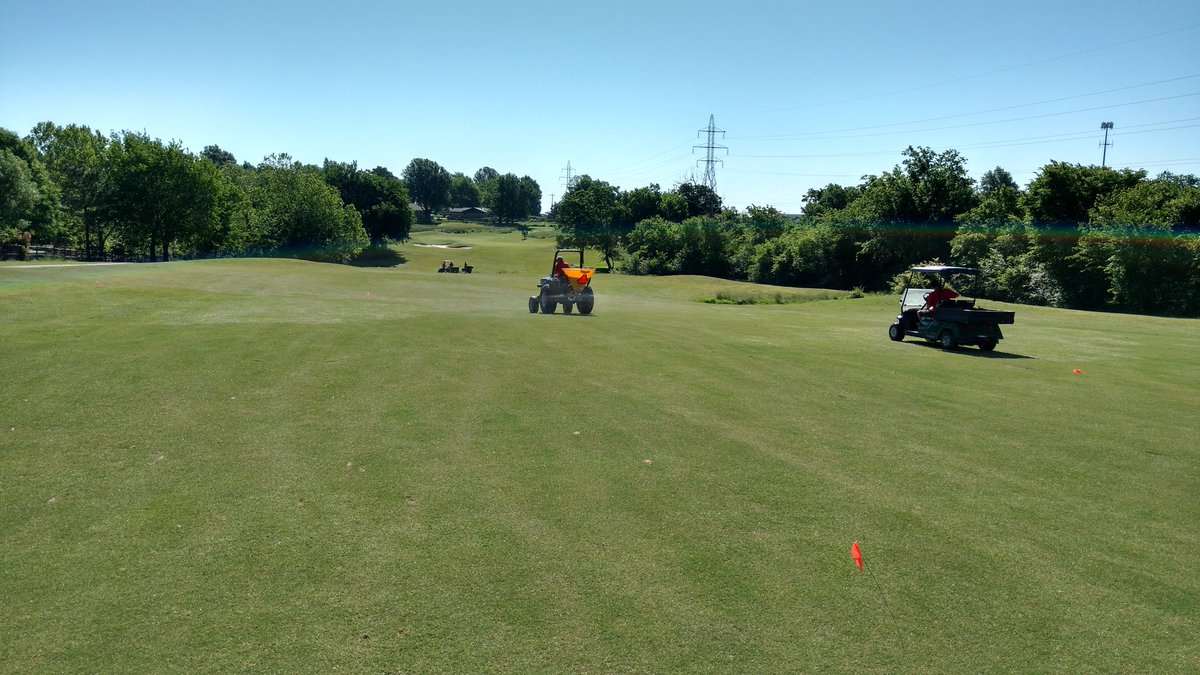
On Tuesday May 10th, the grounds staff applied fertilizer to the entire property (except greens).  The process took two full days and was a coordinated effort from our entire staff.  Douglas Knapp, our chemical applicator, was on the tractor spreader, while someone else followed behind him placing wire flags along the edge of his pass.  This technique assures that fertilizer skips and overlaps are eliminated.  Another person followed Doug in a utility vehicle loaded with product so he could be reloaded quickly and downtime was minimized.  A three person push spreading crew followed the tractor to tie in any small areas or places it couldn't get.  These guys had the hardest job, pushing the spreader over hills, along street crossings, bunker noses, through swales and around greens.  They also had to be sure that any fertilizer that bounced onto the greens was removed with a backpack blower so that the fertilizer wouldn't burn the Bentgrass underneath the granule.

The crew did an amazing job working together to be sure the entire property was treated as evenly as possible.  Over the next few weeks, the color and density of the Bermuda will improve considerably.  Just in time for Memorial Day weekend!


April Course Update


April is always a difficult month for me as I drive around and assess the turf on the golf course.  I call it the ugly duckling phase for the Bermuda on the golf course.  The Bermuda is green but hasn't completely filled in yet.  The mid-season color and density is still a month or so away.  This slow green up is frustrating because once we see green turf, I get excited to start mowing, fertilizing and grooming the surfaces for the season, but the soil temperatures are still not ready to promote steady growth.  Pressure from weeds is typically high during this time while the Bermuda is still not growing and we had our hands full dealing with winter annuals in the rough.  Doug Knapp, our chemical applicator, was very busy spraying selective herbicides throughout the golf course to clean up all remaining weeds.
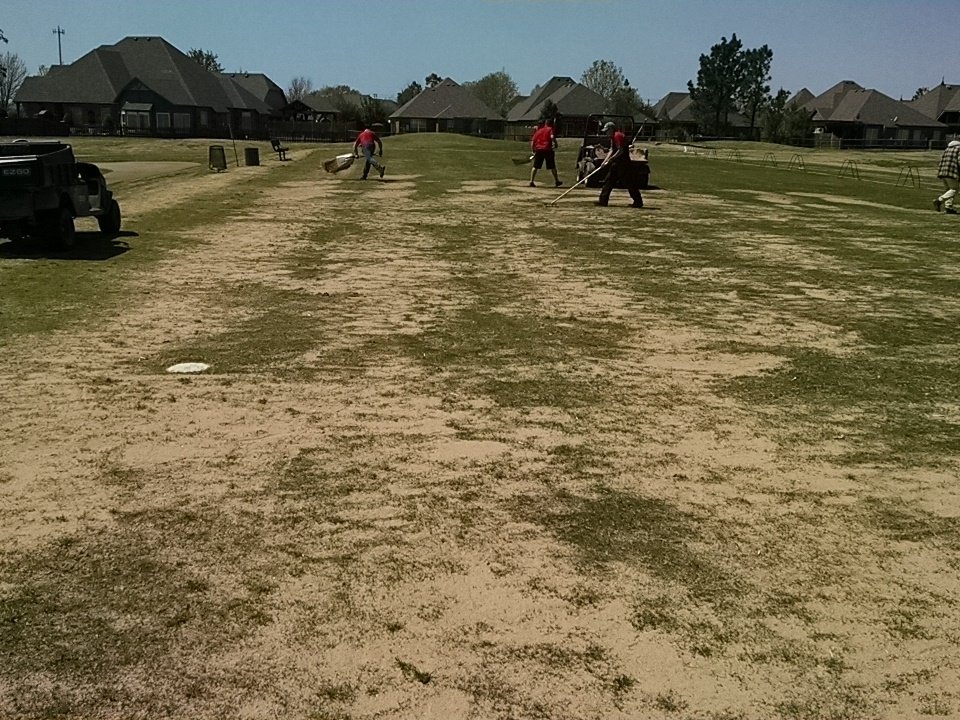
Was great to finally topdress the entire range tee.  Much needed!
Although the weather wasn't conducive for growth for Bermuda, it was ideal for the cool-season Bentgrass on our greens.  Bentgrass loves temperatures in the 60s and 70s with occasional rain showers.  A few weeks of good weather had our greens completely healed in from aeration and looking strong.  This gave us a chance to start mowing and rolling more often to get them ready for the busy spring tournament season.
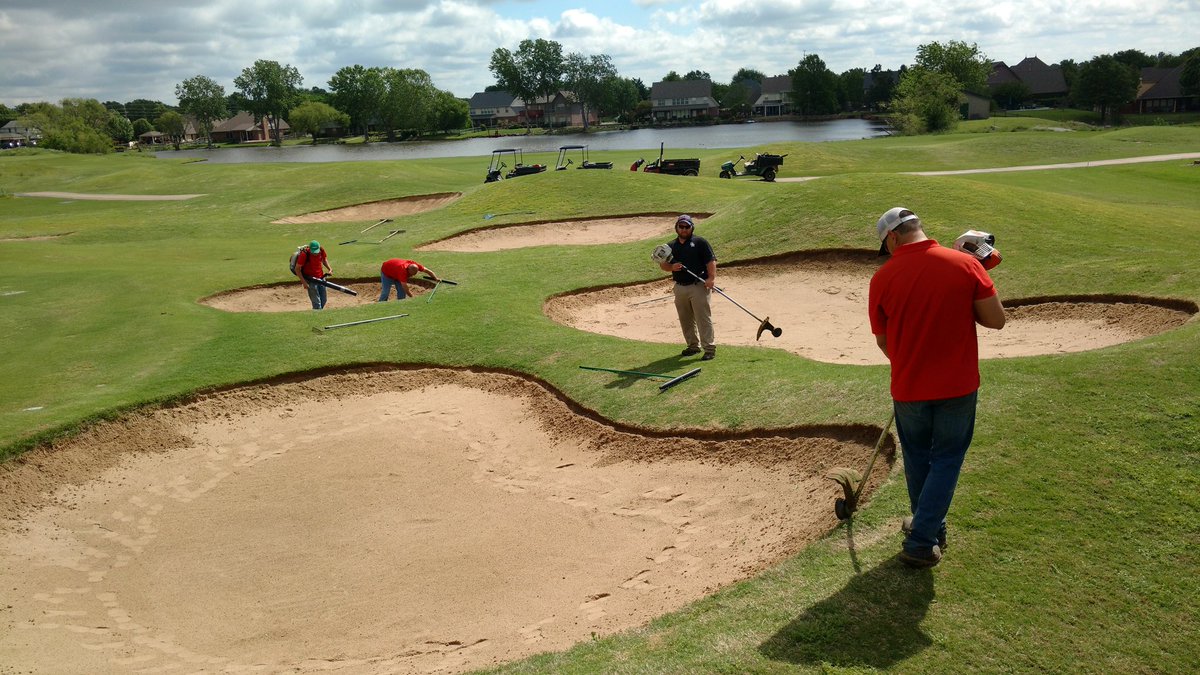
First edging of the season
A few new staff members were brought in and Michael Liebe, our assistant superintendent, has been busy training them on course setup.   In mid April, Joe Miller, our irrigation technician, spent a few weeks cleaning debris out of our greens drainage.  Keeping the drainage system working is critical for the sustainability of our greens.  They cannot survive our Oklahoma summers if they cannot drain.

Besides mowing the tees, fairways, rough, collars and surrounds as necessary, the staff began some of the other regular maintenance tasks such as: edging bunkers, string trim mowing, topdressing divots on tees and mulching the clubhouse landscape beds.  We had planned on using our Aerway slicer on tees and fairways in late April to alleviate compaction from winter cart traffic, but wet conditions kept us from getting that done.  More information on the Aerway process can be found here.
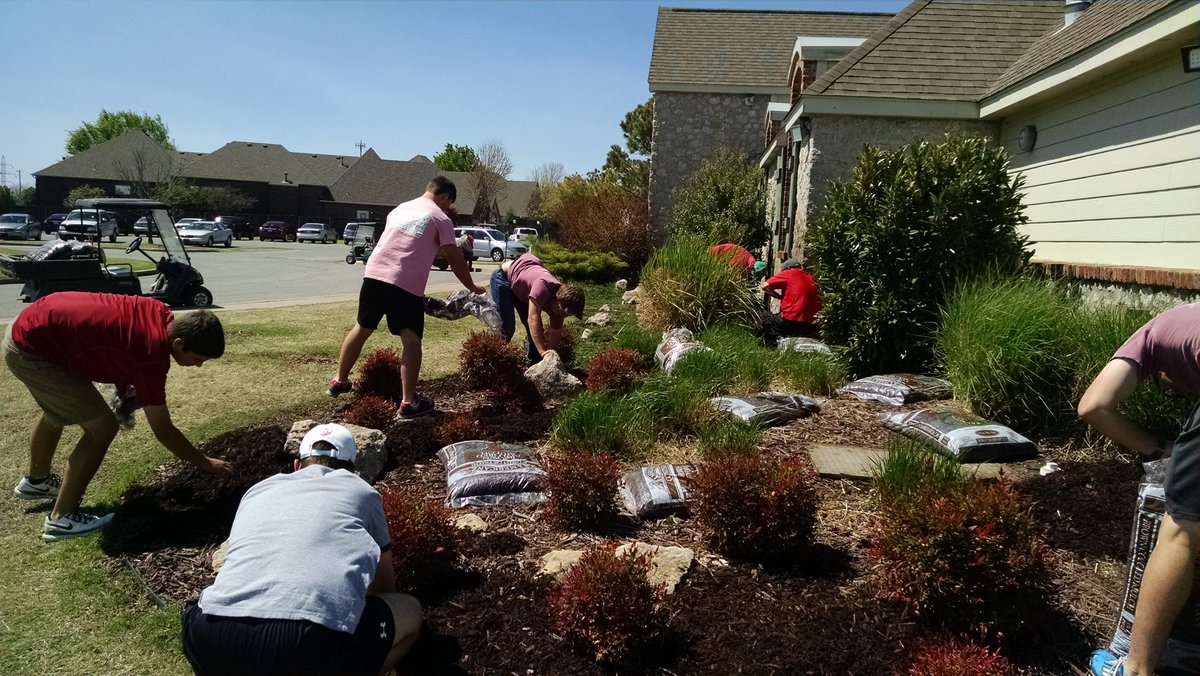
Spruced up clubhouse w/ help from Owasso Rams boys golf team
Although May is usually our wettest month, we tend to have enough nice days to get projects done.  The plan for May is to fertilize all Bermuda course wide, increase mowing frequency, and slice tees and fairways.  This should set the golf course up nicely for Memorial Day weekend and the summer golf season.
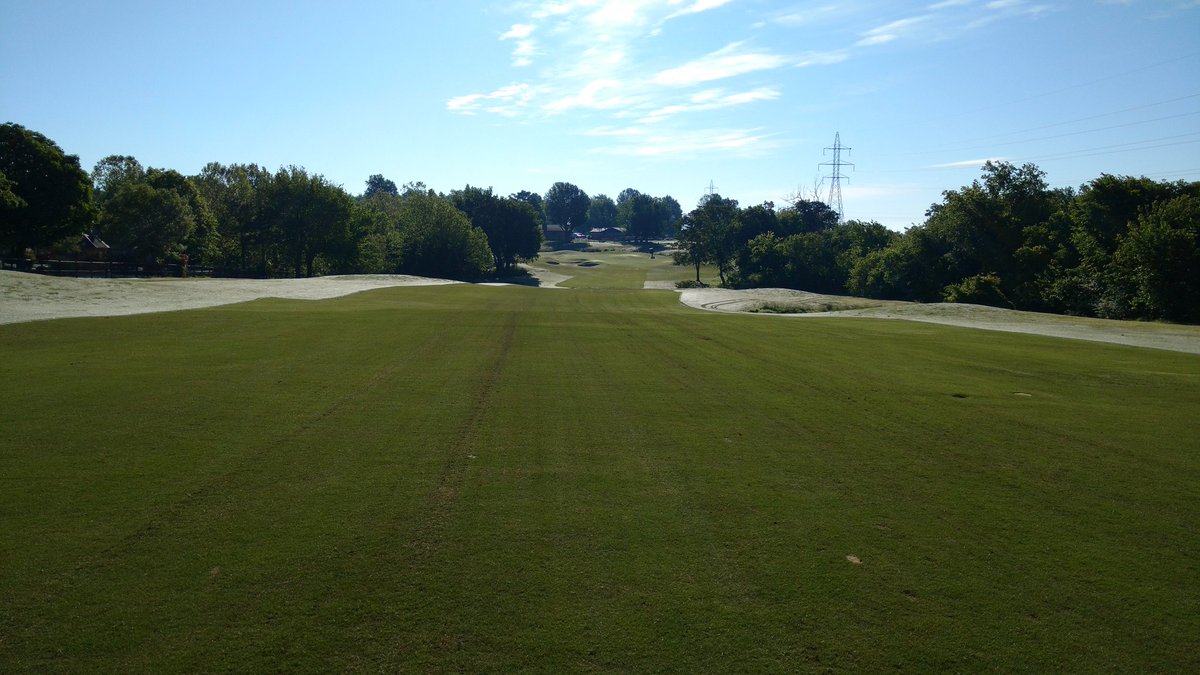


Bermuda was green but not growing much during April

Friday, April 22, 2016

Greens Drainage Preventative Maintenance


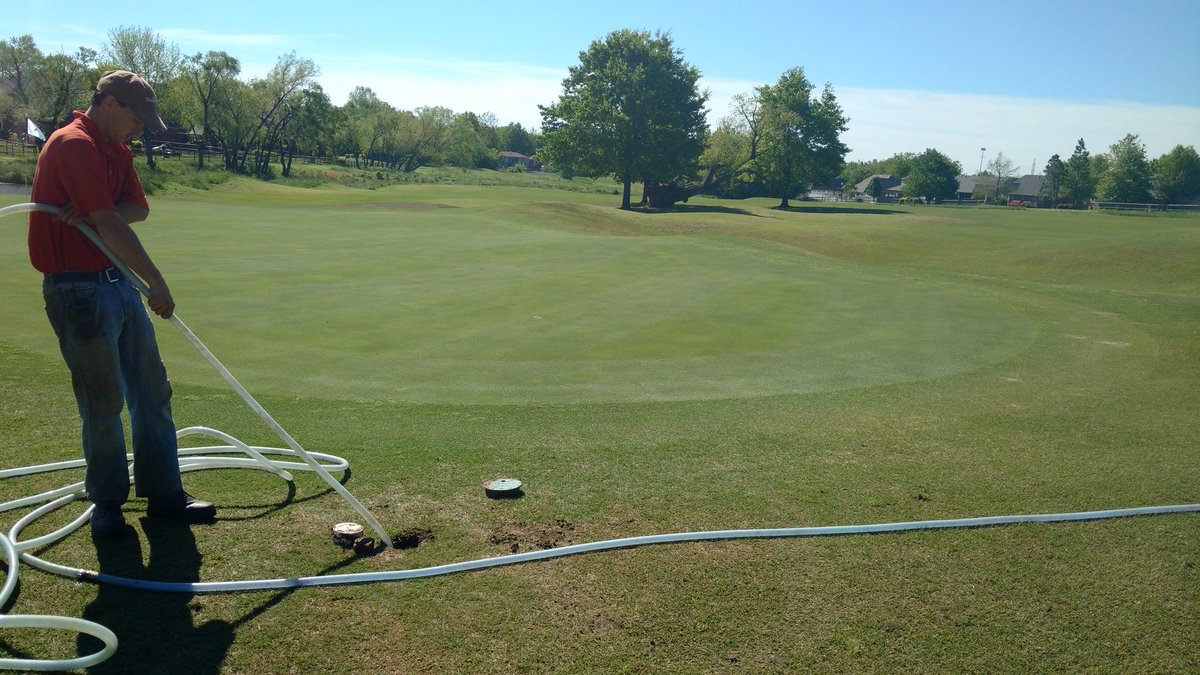
Now that the rainy season is upon us, and summer not far behind, it is the perfect time to perform some preventative maintenance on our greens drainage.  As you can see from the picture above, Joe Miller, our irrigation/drainage technician, spent some time this week flushing clean water through the drainage pipe under the greens. Joe uses a special nozzle, pictured to the right, that does a great job clearing out any debris found in the pipe.

Over time, the drainage system will collect debris and may eventually become clogged.  During frequent irrigation, or rainy weather, the soil inside the greens can fill up with water rather quickly.  A clogged drain doesn't give the water anywhere to go, therefore the root zone will become saturated and stay that way.  This causes the greens to become very soft, disease is more frequent, and the roots will die back up to the surface (making them very short).  This compromised root zone does not allow the turf to handle all the typical stresses of summer, and often results in thin, or dead, turf.

Realizing how important the drainage system is to our success, flushing out the drainage has become a fixture on our annual preventative maintenance schedule.  We feel that by keeping our drainage system working properly, as well as a comprehensive cultivation program, we have the best chance to maintain quality putting surfaces year to year despite whatever weather challenges we may face.


Wednesday, April 6, 2016

Course Update for March

March has always been a transition month in this part of the country.  Some years it can be warm and give you an early start to the season.  Other years, it can be cold and just another month of winter.  Most often it's a little bit of both.  This year March started off mild and had all of us thinking we would get an early start to spring.  Leading up to, and during, core aeration in mid-March, the temperature was above average and had all the short-cut turf waking up rather quickly.  Since then, we've had a handful of frosts that have effectively shut down any additional green up.  We've actually lost color since mid-March.  This is the most frustrating part of spring in this part of the country.  You get excited about greening up and getting a good start to the growing season, and then winter reminds you that it's still early and not done yet.

Aside from the weather, the staff was very busy,
not only finishing up our winter to-do list but, working on preparing the course for the season.  Core aeration on greens, stump grinding, course wide pre-emergent application, topdressing divots on tees, and mowing all surfaces. March is also when our seasonal staff begins to return and so much of our time was spent training them on course setup and other tasks.

With March behind us, and much of the critical spring work is completed, we can begin to settle into our maintenance programs and groom the course as it continues to wake up from winter.  Over the next 30 days, we will continue to acquire/train staff, increase mowing schedules, and ramp up our cultural programs (venting, spiking, verticutting, topdressing).

Wednesday, March 30, 2016

Spring Pre-emergent Application


Another key project the grounds staff completed this week, was our spring pre-emergent herbicide application to all Bermuda on the golf course.  This application is very time sensitive and critical to the overall cleanliness of the golf course during the season.  When dealing with pre-emergent herbicides, timing is very important.  I'd rather apply two weeks too soon than a day late.  Pre-emergent products are, by definition, only designed to control weeds before they germinate.  Therefore, if you wait too long, and the weeds germinate, there will be no control of the weeds and your time & money is wasted.  The general time frame to control summer annual weeds, with pre-emergent herbicides, in this part of the country, is mid-March to mid-April.  So if any of you homeowners are reading this and have been putting it off, get out and put down your pre-emergent products in the next week or so before it's too late.  

As you can see from the picture above, the pre-emergent was applied using our fertilizer spreader.  Purchasing the herbicide coated on a fertilizer granule is the most efficient and cost effective application method.  It took our staff less than two days to apply the product versus almost two weeks if we sprayed it using our spray rig.  A little accuracy is lost during the application by using this method, but the savings in time make up for it.  This application will keep our weed pressure down until the product starts to wear off in mid-August.  We will then go out with another product in late September to guard against winter annuals.

Stump grinding


This week,  we rented a stump grinder and removed all the tree stumps throughout the golf course.  Many of the tree stumps were left over from some tree work this past winter, however, several of them have been around for much longer.  Several of them are a couple of years old and we just hadn't been able to get to them.  Removing all the old stumps around the course will make it easier to mow and reduce the amount of trim mowing we have to do.

Spring Greens Aeration

March, in our part of the country, is the beginning of the golf season.  It is also when many parts of the golf course begin to wake up from their winter slumber with the Bentgrass on the greens being the first turf to wake up.  Although we may mow and change cups occasionally leading up to mid-March, once we core aerate, that seems to be the beginning of our season.  As turf growth increases, the staff will begin to input more resources (topdressing, fertilizer, verticutting, handwatering, etc).  One of the most important processes we can do to maintain great greens is core aeration.
Core aeration is critical to the overall success and sustainability of the putting surfaces.  Aeration improves plant health by improving the oxygen content, and drainage capacity of the soil.  Improving the oxygen content helps encourage healthy soil biology and allows the turf to cope with all the stresses we throw at it throughout the season (low/frequent mowing, foot traffic, shade, heat, etc.).  

The process physically removes cores of soil and turf at a designated diameter and spacing.  We use those parameters to determine the total amount of material removed each time we aerate.  Once the cores are removed and then cleaned off the green, pure sand is added to the surface and then brushed into the holes.  The sand is added into the holes for two reasons.  First, it stabilizes the soil, because that many open holes would leave the green soft and almost unplayable.  Second, it helps dilute the organic material in the soil that couldn't be removed during the process.  As you can see from the pictures to the right, a lot of material is removed during the aeration process.  This will firm up the greens and allow us to maintain optimum plant health throughout the season.  A follow up aeration will be performed in September.

Tuesday, March 8, 2016

DryJect Application on Greens


Last week, the grounds staff brought in Robert Main, with Turfgrass Solutions, to use DryJect machines on select areas on the greens.  The DryJect process uses water pressure to fracture the ground and decompact the soil.  This water then creates a void that is filled with sand or another amendment.  The quick blast of water creates a vacuum which pulls the sand from the hopper above, down with it as it leaves the nozzle.  The graphic to the right shows the process.

Although the process is violent and is aggressive in the soil, at the surface all that is left is a small amount of sand at the top of each hole.  After the machine is through, the green is then rolled and brushed to smooth the surface farther.  We completed this project last Thursday and did not close any holes.  In fact, the member skins game played on the competed greens hours after we'd finished and they couldn't believe how smooth and fast they were.  Then on Saturday morning, while I was on the 1st tee chatting with members about the process, I was very pleased to hear the number of compliments on the process and final result.

Although the DryJect process creates channels of sand in the profile similar to a traditional core aeration, it is not meant to replace the traditional hollow tine core aeration process.  Rather, it is meant to be a supplement to an already established program.  After discussing the process with the rest of the staff, we feel that this process could be a great option if our soil tests dictate more aeration is needed but cannot withstand the amount of surface disruption and lost revenue from discounted rounds and lost play during the height of the golf season.


Wednesday, February 24, 2016

Service Vehicle

The spray rig with the tank and booms removed. Ready for the next step.
A month ago, during some winter weather, the staff spent a few days repurposing our old spray rig into a service vehicle for Dan Welborn, our equipment manager.

I've wanted our equipment manager to have a service vehicle for several years but never felt we had a viable option until recently.  A few years ago, we bought a new John Deere spray rig but decided to keep the older Cushman spray rig so we could use it as needed.  Over the past few years, we haven't used it nearly as much as we anticipated and it has sat for over a year collecting dust in our chemical storage room due to costly repairs to the spray module that would be needed.  I decided that it wouldn't make any sense to spend over $3,000 to get it back into condition as a spray rig.  Although the spray module was a mess, the vehicle was still in good mechanical shape.  The staff disassembled the module and we took stock of the condition of the vehicle and decided to proceed with the project.  The picture above shows the vehicle with the spray tank and booms removed.

The most involved part of the project was fabricating the flatbed and attaching it to the frame of the utility vehicle.  As you can see from the pictures to the right, stock steel was purchased and each piece had to be custom made to fit.  The whole process took two days.  Once the flatbed was welded together, it was primed and painted.


The last step was to bolt all the accessories to the flatbed.  The purpose of the vehicle is to allow the equipment manager to quickly react to an issue on the golf course quickly so that equipment downtime is minimal.  Service vehicles will be outfitted differently at each golf course due to different demands.  Each accessory chosen reflects the common problems that Dan will face throughout the season.  A generator to supply power for various hand tools, a compressor for tire work, a tool box full of various hand tools, storage for tire patch kits and other misc. supplies, a vise for various tasks, and a winch mounted under the back for helping machinery when they get stuck.  As you can see from the final picture at the bottom of the post, there is still some space available along the passenger side for additional storage box and some undermount boxes behind the rear wheels.  These will be purchased next year when funding is available.

The staff did a great job taking an old machine that wasn't in use any more and making it useful again.  We are excited to have the vehicle in our fleet and expect it to be very useful throughout the year.


All painted! Ready for tools

Finished product!


Golf Industry Show

I'm a little late in writing this post, but a few weeks ago, Michael, my assistant, and I were fortunate to be able to attend the Golf Industry Show in San Diego, California.  The GIS is the annual Golf Course Superintendent's Association of America trade show and educational conference.
Lots to see w/ over 250,000 sq.ft. of exhibitor space

The Golf Industry Show is the place to network with industry peers across the country and the world.  The numerous educational seminars offer a wide variety of topics for superintendents to sharpen their skills and the trade show offers all the latest and greatest the manufacturers and suppliers have to offer to the industry.  It never fails in the few short days that I get to attend, I come away with something new to offer our club.  Whether it's new techniques to improve course conditions, or a new way to complete an in-house project more effectively, meeting new friends or catching up with old friends, the GIS offers many ways to come home invigorated and mentally ready to give the upcoming season my best effort.


Goodbye San Diego!

Friday, February 19, 2016

Bluebird Nestbox Program

One of the biggest reasons I got into the golf business is to work outside and enjoy nature.  I firmly believe golf courses are an integral part of the environment and are often the only place where wildlife can live as communities continue to grow.  As the golf course superintendent at Bailey Ranch Golf Club, I have a direct impact on our facilities environmental footprint, and I take that responsibility very seriously.  There are numerous ways we, as a facility, work towards environmental stewardship such as: water conservation, soil testing, scouting for disease and pests, reducing maintained acreage, grass buffers along pond banks to improve water quality and encouraging wildlife habitat.

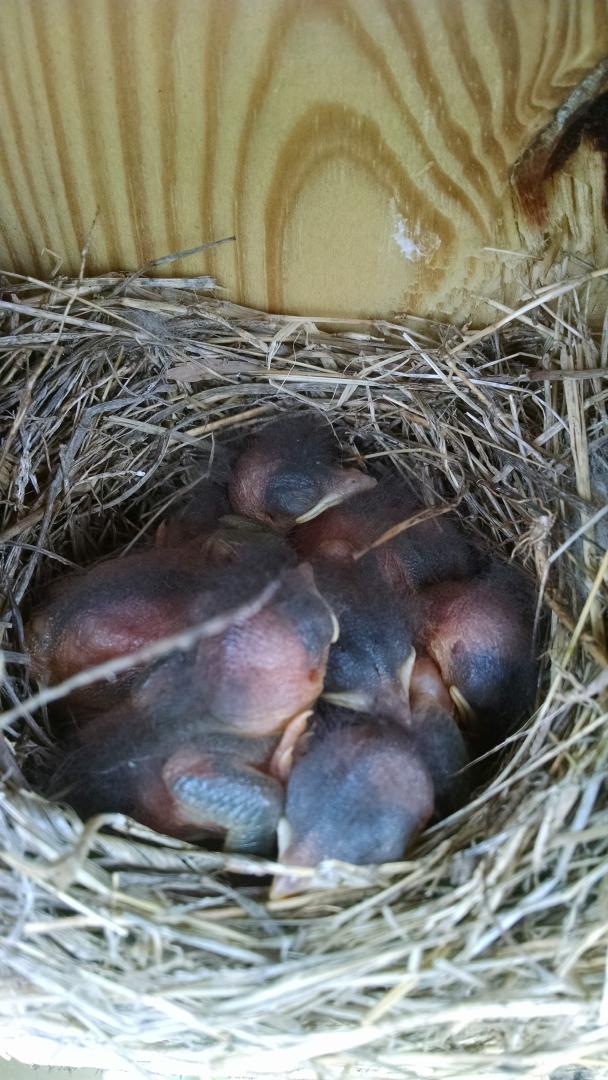
Wildlife habitat is one of the best ways a golf course can benefit the environment.  With this in mind, one of my big initiatives last year was to begin a bluebird nest box program.  With the help of the Oklahoma Bluebird Society and the Oklahoma Department of Wildlife Conservation, we constructed and placed 12 nest boxes throughout the golf course.  We then monitored the boxes throughout the year so we could track any progress.  At the end of year, we submitted our results to Oklahoma Department of Wildlife for their Bluebird Nest Box Survey.  We just got their final report and it seems that Bailey Ranch Golf Club was the only entity, public or private, that reported any results in Tulsa County.  Although we only had three nests and 24 fledglings, I'm pleased with the progress we made in our first season. As the program continues to grow, our goal is to have nests in every box each season, and eventually expand the program into other areas throughout the property.