Thursday, September 18, 2014

Greens Aeration Recovery

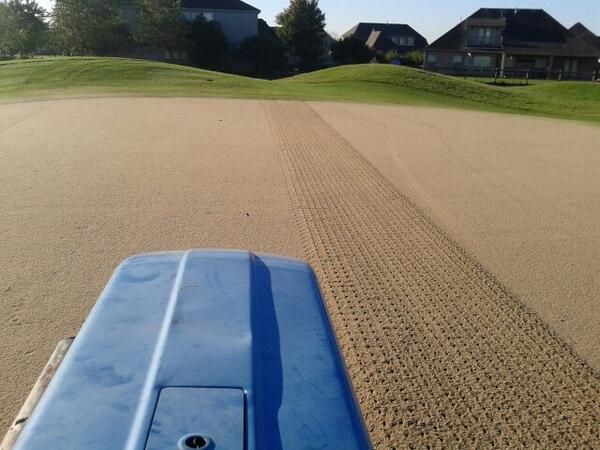
These 5/8" holes are almost filled in
It's been just over one week and greens seem to be right on track regarding aeration recovery.  Aeration is an aggressive process that takes typically 7-14 days for full recovery depending on several factors such as: tine size, soil moisture, weather and the growth rate of the turf.

Leading up to the process, the soil moisture is carefully monitored and nutrients are applied to maximize the growth potential.  After the process is completed, the greens are rolled and brushed for a few days until we feel that the sand has been worked into the canopy as much as possible.  Mowing is withheld during the first few days after the process is complete to allow the turf to growth through the sand and to allow the roller a few days to smooth the surface.

The first few days of mowing are primarily used to pick up the larger granules and excess sand that won't work into the holes.  This is a messy process which quickly dulls the mower blades and requires the staff to clean up the debris left behind.  Each day the clippings that are collected are inspected to monitor the ratio of sand to grass.  Initially, the buckets will be mostly sand and very heavy.  After a few days, the sand amount will
Minimal sand in clippings
decrease and the ratio will become about 50/50.

With almost a week of mowing sand, the reels were very dull and in need of sharpening.  This morning, with a freshly ground reels, we were pleased to see almost no sand in the buckets.  The photo on the right shows a handful of clippings from this morning.  Now that we are phasing out of the sandy portion of the recovery process, we will begin using our newer greens mower which will give us a much better quality of cut.  Once all the holes are filled in, we will slowly lower the height of cut from .135" back down to .120" for the fall tournament season.

As always, if there are any questions regarding the aeration process or subsequent recovery, please feel free to ask.  Thank you for your patience during this time.  

Bunker Maintenance

Sand is added where needed
Today, the grounds staff has begun checking sand depths in bunkers.  The grounds department completes this process 1-2 times a year depending on weather, play and other factors.

The staff takes measurements throughout the bunker looking for sand depths to be approximately 4-5" in the bottom and 2-3" on slopes.  Sand is then added to areas that do not meet this requirement.  We've just about got the front nine done and will work to finish the back nine by next week.

Then spread around until depths are on target
The grass around bunker edges has gotten away from us lately and we will be putting a fresh edge on them next week as well.  The staff should have the bunkers shining by the end of next week.

Thursday, August 28, 2014

Fall Aeration Rescheduled

After looking ahead to next week's weather, the decision has been made to postpone greens aeration until Tuesday September 9th and 10th.  The forecast calls for highs in the mid to high 90's, which is too hot to complete the process.  Aeration is inherently a stressful process and we need the greens to be ready to handle the stress.  If they are under heat, or drought stress, they will be more prone to injury during the aeration process.  We believe that pushing back the process one week, should allow the temperatures to come down into a more favorable range.

We will continue to monitor the weather and post any further changes, if any, to the schedule.  Thank you

Friday, August 22, 2014

Fall Greens Aeration


It's hard to believe, with this current heat wave, but fall aeration on greens is just around the corner.  On Tuesday September 2nd, the grounds staff will begin aerating the front nine greens.  This will allow play to continue on the back nine.  On Wednesday September 3rd, the front nine will be back open and ready for play while the back nine greens are aerated.  The practice greens will aerated on Wednesday morning.

Aeration is a key practice performed each spring and fall that promotes improved soil drainage, oxygen content, and root density.  For more information about the process and how it is performed, stay tuned.  Once the process is complete, I will post pictures that help explain how it is done.

Wednesday, August 20, 2014

Getting Caught Up

Embedded image permalink

This week, the grounds staff has been hard at work getting caught up on all the mowing on the golf course.  Tees, fairways, approaches and surrounds have all been cut at least twice this week.  The height of the rough was the main topic of conversation over the past week and we have made a lot of progress.  By the end of the week, we will have all rough cut back down to two inches.  Please excuse all the clippings in the rough as a result of all the mowing.  The staff will work hard to ensure all short turf is cut and clean for the weekend.

One Last Meal


Each year, in August, the grounds staff focuses on giving the course one final dose of food to get carbohydrates stored up before winter.  Winter injury of Bermudagrass is a big concern in this part of the country, and while we can never truly prevent winter injury if the weather gets really cold, providing a timely amount of the right nutrients will give the plant a fighting chance.  Douglas Knapp, our chemical applicator, has been hard at work this week applying a 10-5-22 blend of fertilizer "wall-to-wall", meaning that all maintained turf on property, minus greens, was treated.  There is approximately 77 acres of maintained Bermudagrass on property that had to be treated and the staff was able to complete the application in about 10 hours.

For those who may not know, whenever you are looking at fertilizer bags, the three numbers on the front label are the percentages by weight, of Nitrogen, Phosphorous, and Potassium, in that order.  For fall applications on Bermuda, we always look for just enough nitrogen to sustain growth into October and let the plant naturally slow down into dormancy.  You never want to apply high rates of nitrogen past mid-September, because it will cause the plant to become succulent and it will be susceptible to winter injury and disease in the spring.  The main reason we choose this analysis is for the last number, the Potassium.  Potassium has shown to be helpful in reducing the risk of winter injury in Bermudagrass in the transition zone.  This analysis allows us to give the plant a high dose of this key nutrient just before it starts storing energy for dormancy, while keeping the amount of applied nitrogen relatively low.  Also, there is a small amount of Phosphorous included in this mix to help encourage root density going into winter.

Once watered in, the fertilizer should begin to take effect just in time for Labor Day weekend.  The plant response should last through October and set the course up very well for the upcoming busy tournament season!

Saturday, August 2, 2014

Tall Rough

With all the beautiful weather lately, it's hard to find many things to complain about, but one issue that has surfaced a lot lately is the height of our rough.  I couldn't agree more.  The recent rain storms have prevented us from sticking to our mowing schedules but have managed to keep up with our tees, greens, fairways and surrounds fairly well.  The main factor contributing to the tall grass has been the numerous mechanical issues we've encountered with our rough mower.  We've been borrowing and renting equipment, to do our best to keep up, but haven't been quite able to get 100% of the rough cut each week.  This leaves us with rough throughout the course with various stages of growth.  Some areas aren't too bad, while other areas, mostly wet areas, are getting very tall.  Mitchell, our equipment manager, has worked tirelessly to remedy the mower issue and we are looking forward to a dry week next week so we can get caught up.  I realize this is frustrating and appreciate your patience during this time.

As always, if you have any questions, or additional concerns, just let me know.  Thank you.

Monday, July 28, 2014

Course Update


The recent cool down in the temperature has allowed me to take minute and reflect on the weather and other topics related to the course in this latest course update.  The weather, good or bad, always seems to be the main topic when discussing the golf course.  Although we recently had some hot weather, overall, the weather has been very mild.  Daily highs have been very close to seasonal averages, which seems very cool compared to the past few summers.  Due to this cooler weather, the turf across the entire course is loving this weather.  The cultural practices, fertility program and water schedule has all complimented perfectly with the weather to produce some of the healthiest greens we've ever had this time of year.  The picture to the right shows roots coming out of the bottom of the 5.5" soil probe.  Usually, during July, we are trying to hang on to 3" roots until fall.  Longer roots have allowed us to keep firmer conditions while maximizing plant health.

As for the rest of the course, the staff has had their hands full keeping up with the mowing schedule for all short turf (tees, fairways, approaches, collars, and surrounds).  The intense growth rate has caused us to stay very busy keeping up.  The rough has been the only real concern this year.  Due to some mechanical issues with our rough mower, we've had to utilize rental mowers and loaners to keep the rough cut.  During this time, portions of the rough have gotten away from us and have become unacceptably tall.  We apologize for this and are working diligently to get the course cut back down to improve playability.
Rough at edge of fairway on #11


Over the past few weeks, staff has been working hard to get all the native areas and pond banks cut down.  Mowing these areas 2-3 times a year helps to clean out all woody plants and gives the native grasses the advantage.  Over time, the grasses in these areas will continue to thicken up and the end result will be a nice, clean stand of turf.

 Over the past month, golfer feedback has been overwhelmingly positive with many people commenting that they haven't see the golf course this nice in many years.  We, in the grounds department, appreciate all the compliments and will continue to work hard to make Bailey Ranch the best value in the Tulsa metro area.

Looking ahead to the fall, the golf course should continue to shine and as the weather cools down.  We are looking forward to finishing 2014 golf season on a high note!

Wednesday, July 2, 2014

Tee Aeration

Kyle pulling cores on #10 tee 
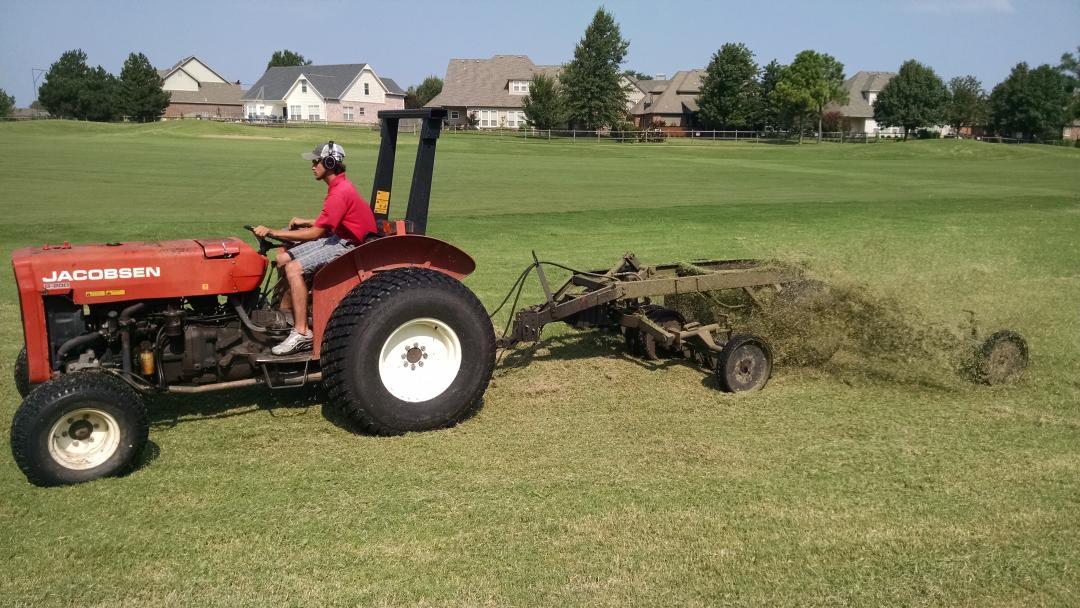
Those of you who've been out on the course the last few days have noticed the grounds staff pulling cores on tee boxes this week.  You may be wondering why we are messing up the tee boxes when they look so nice.  Core aerating any turf when it's at the highest growth potential will minimize recovery time, and mid-summer is the ideal time for aerating Bermudagrass.  As you can see from the picture to the right, the first step is pulling a core with our tractor mounted aerator.  Once the cores have all bee pulled, the tee is drug with a steel mat to break up the plugs.  The soil from the plugs is re-incorporated back into the holes, while the thatch is left at the surface to be blown off into the rough.  Once the tee is cleaned off, the tee is mown again to finish off the process.

Pulled cores on #4 tee
Over the years, I've spoke of the benefits to aerating turf many times, but it's importance can never be understated.  Aeration is critical to the overall health and sustainability of any turf by providing key benefits such as: promoting deeper roots, increasing soil oxygen content, removing thatch, reducing soil compaction, and improving soil drainage.


Staff cleaning up cores on #6 tee
It should go without saying that there is a lot of hard work involved with this process, and although we would love to accomplish this project without impacting play, we realize that is not feasible.  We appreciate your understanding and patience during this process.  As always, if you have any questions, or concerns, regarding this project, please let me know.  

Finished product on #6 tee

Sunday, June 15, 2014

Thoughts on US Open

9Before&After

Over the past few weeks, leading up to the U.S. Open, I've been increasingly asked about the new look of Pinehurst #2.  In general, reactions to the changes that have taken place are mixed at best.  It seems that you either love it or hate it.  I for one love it.  For a long time, I've lamented the perfect, verdent conditions our member,s and guests, see on TV each weekend.  While I'm sure none of them expect the same conditions at our facility, given our resources, it's impact on our industry is not lost on me.  For decades, golf course conditions on TV have influenced general opinion in this country about what a good golf course should look like.  This is typically referred to as the Augusta Syndrome.  The USGA, to their credit, has had sustainability and water conservation at the forefront of their efforts for several years now and it seems coordinating back to back mens and womens U.S Opens this year at Pinehurst, and next years Men's U.S. Open at Chambers Bay, is no accident.  It seems they indend to put firm, fast, and brown courses in front of the masses in hopes of curbbing public opinion.  Will it work?  I hope so.  My biggest hope is that by watching these tournaments, the average golfer will realize that courses don't have to be lush and green to be considered good.  Using a little less water and fertilizer is not only cheaper, it's better for the environment, and playability is often improved.  Drives roll farther, and greens roll faster. 

Now, I realize that not all facilities are going to be able to do what Pinehurst has done, but I believe they must take steps, however small, to reduce their footprint and cut costs.  I think that the ability of any golf course to reduce its inputs depends on it's geography, design, and whether or not they have grasses that are adapted to the area.  Courses in the transition zone with cool-season tees, fairways, and rough, are going to have a very tough time reducing water usage, and other inputs, without losing grass.  Courses like Pinehurst and Chambers Bay, contain grasses that are acclimated for their locations and can withstand a fair amount of environmental stress without dying.  

#14 fairway
Here at Bailey Ranch, we've always been strigent with our inputs.  We rely exclusively on stormwater runoff which forces us to use water sparingly, and limited coverage with our irrigation system causes the turf in the fairways and rough to turn dormant.  The membership has been very accepting of this due to the increase in ball roll in fairways and thinner lies in the rough.  Also, the drier conditions fit nicely into the links design aesthetic of the course.  Over the past few years, our department has converted 10 acres of maintained rough without irrigation coverage to native areas to help further reduce inputs and increase native habitat. 

Many colleagues at courses similar to us will be able to say they're doing, or not doing, the same things that we are, mostly due to budget constraints, but my point is that its nice to finally see a course on TV that isn't perfectly manicured from edge to edge.  Even if their budget is still 2-3 times ours.  It's important for the future of the game that water conservation, and sustainability, not just be talked about, but put on display for the public to see and get comfortable with.


#8 native addition

Friday, June 6, 2014

Project Bluebird Update

Bird box near #10 tee
  In February, the grounds staff, cooperating with the Oklahoma Bluebird Society, constructed and installed Bluebird boxes in select areas around the golf course.  During the initial stages of this project, we quickly learned that there was a lot we didn't know.  The boxes were constructed and redesigned several times to ensure the birds would use them, and that other animals, such as snakes, squirrels, and other bird species, couldn't interfere.
  
Throughout spring, we began to see an increase in bird activity near the boxes, but hadn't seen evidence of nesting.  Over the past few weeks, we've noticed some nesting building.  I peeked into the box near #10 tee and saw a large nest containing eggs and what appears to a hatchling.  Incubation is only 12-14 days from the time they are laid to when they hatch.  Once they hatch, it takes only 19 days until they can fly from the nest.  The old nest material will be removed once the young are fledged from the nest.  Bluebirds can have 2-3 families each year and a new nest will be build each time.

I am very excited to have this much activity in our nests in our first year.  I hope that each year, the population grows, and we can incorporate more boxes throughout the property for everyone to enjoy.

Tuesday, June 3, 2014

Course Update for May

May is typically a transitional month where the cool nights and days of spring give way to the warmer weather of summer.  Although delayed, this May proved to be no exception.  The first three weeks of May were anything but ideal weather for Bermuda growth.  Cool nights, cloudy days and lack of rain, had our Bermuda on "stand-by" waiting for summer come along.  Then all of the sudden, the pattern changed drastically with day temps in the high 80's to low 90's, and abundant rainfall.  If you include the rain from last Monday morning, we've had enough rain in the past seven days to double our annual rainfall total.  
Removing thatch from green
May is also a time full of transitions operationally.  Seasonal staff have been brought in to begin mowing schedules as well as cultural programs such as verticutting, slicing, and topdressing.  Douglas Knapp, our chemical applicator, is going full throttle keeping up with all our fertilizer, and pesticide applications.  Joe Miller, our irrigation technician, is busy maintaining our irrigation system.  Lastly, with more equipment leaving the shop each day, Mitchell Pierce, our equipment manager, has to spend most of his time adjusting and sharpening mowing equipment.  
topdressing green to dilute thatch and firm surface
Despite a slow start to the month, I feel that all the work completed by our dedicated staff, coupled with favorable weather, caused the course to peak right before Memorial Day weekend.  June is starting out with great conditions on the course and should be a great month for golf!


Bermuda is flush with growth from recent weather!

Tuesday, April 29, 2014

Tee slicing

Embedded image permalink

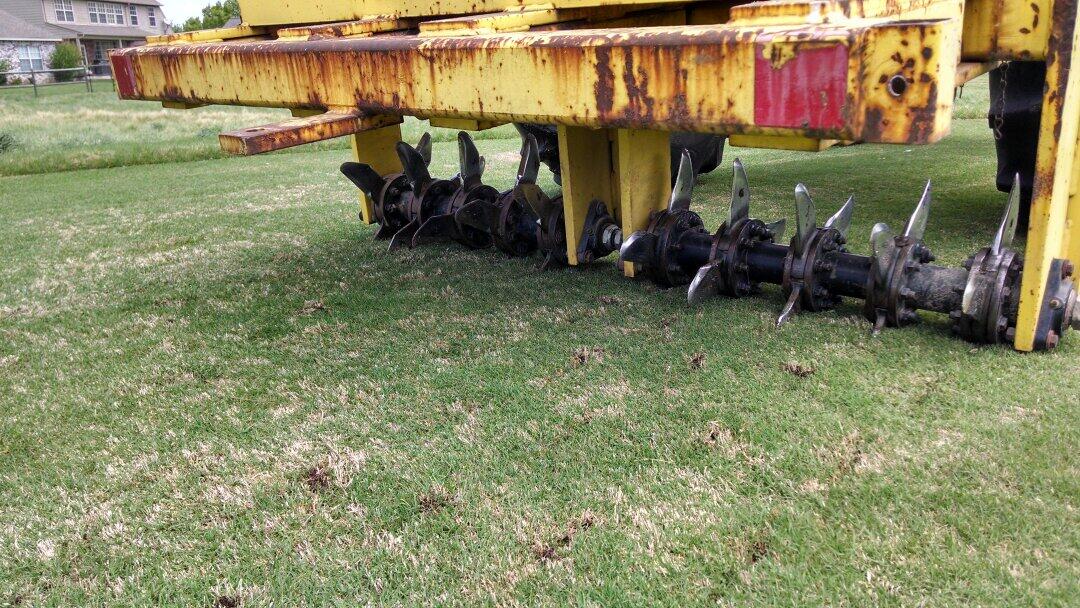
This week, the staff is decompacting tee boxes using the Aerway shattertine machine.  This is the same unit we used on fairways a few weeks ago.  The shattertines torque as they go into the ground which helps loosen and fracture the soil.  The tees are then mowed to clean up the tufts left behind.  Doug, our chemical applicator, is following the slicing project with an organic fertilizer to encourage some more growth.  Once the weather starts cooperating and begins to warm up, the tee boxes should start to fill in quickly.


Tuesday, April 22, 2014

Rotary Presentation

This afternoon, I had the pleasure of speaking to the Owasso Rotary Club about two passions of mine: golf and the environment.  I appreciate them allowing me to speak and they were a great audience.  I've embedded a copy of the presentation below for those who are interested.

Monday, March 31, 2014

Course Update March 2014


March, in many ways signifies the end of our winter off-season, and the beginning of the golf season.  Seasonal staff begins to arrive to ready the golf course for the season, the weather starts warming up, winter projects are wrapped up, and many of our chemical and cultural programs begin.  The following is a brief update on what happened in March.

The grounds department began taking on seasonal staff, March 1st, to help keep up with the growing list of tasks and projects.  March is a time when course preparation tasks like mowing greens, raking bunkers, moving tees and emptying trash cans is done much more frequently and seasonal staff is needed to accomplish this.  Next month, 4-5 more seasonal staff will be added as the Bermuda begins to awaken and the summer mowing schedule is phased in.

In typical fashion, the weather over the past month has been anything but predictable.  The temperatures went from 7 degrees to 82 degrees in 9 days.  Some days the wind was calm and other days the wind gusted to 50+ miles per hour.  Despite the inconsistent weather, the grounds staff made the best of the situation and accomplished many tasks that are vital to a successful golf season.

North bunker edge reconstruction
The bunker project on #13 was completed.  This bunker required a little more work than just removing and replacing the sand and drainage material.  We determined that the northern edge needed to be elevated 12-14 inches so that water from the basin to the north would not back up into the bunker anymore.  This basin drains slowly which causes stormwater to back up into the bunker, bringing with it silt, grass and other debris.  Raising this bunker edge allows the bunker to only deal with the water that falls within it's own footprint, greatly extending the lifespan of the drainage.

Finished product on #13


Earlier this month, Doug our chemical applicator, finished applying the pre-emergent herbicides.  This process takes 2-4 weeks depending on the weather and is vital to the success of our weed control program. We always aim to complete the spring pre-emergent application prior to greens aeration, and Doug was able to meet that deadline.  The golf course is largely weed free and once the Bermuda starts coming out of dormancy, there should be an easy transition with little competition from weeds.

Although greens aeration had to be delayed one day due to frozen conditions, once we started, the project went as planned.  I couldn't be more proud of the staff and the finished result.  The process is very complex and involves many steps, the staff was able to complete all work on schedule completely in-house, with no temporary labor.  For a detailed look at the various steps involved, click here.


As I assess where the golf course right now, I believe the course is primed and ready for the warmer weather of April.  As always, if you have any questions or comments, please feel free to contact me.

Monday, March 10, 2014

Course Update (Winter Recap)

The days are getting longer and, although we still have a few weeks of winter left, spring is just around the corner.  I wanted to take a few minutes and highlight some of the work the grounds staff has completed this past winter, which will improve playing conditions and make your round more enjoyable.

Behind #12 green looking to the NW
Each winter, the grounds staff spends 2-4 weeks pruning trees that are either damaged, overgrown, or are causing poor growing conditions for the turf.  Occasionally trees must be removed if they inhibit growing conditions around greens.  This year, the notable removals were behind # 12 green and right of #13 green.  These trees were causing thinning turf and bare spots within a short distance to the putting greens.  The ability to grow quality turf in these areas will have an immediate positive impact on playing conditions.

The latest project that was completed was a bunker renovation on #13.  Over the past year, we began to notice a decline in the bunker's ability to drain.  The grounds staff removed all the old sand and drainage pipe, then replaced it with new material.  The renovation process should give us 5-8 years of quality playing conditions.

Height of cut is maintained to the thousandth of an inch
During the off-season, Mitchell Pierce, our equipment technician, has worked tirelessly to ensure that all the equipment needed for the season is finely tuned and ready to go.  Much of his time has been spent sharpening cutting units, rebuilding hydraulics, replacing bearings, and other miscellaneous tasks.  Without his work, we would not be able to meet the expectations of the golfing public.

Douglas Knapp, our chemical applicator, has been hard at work this off-season, spot-treating weeds and applying our course wide pre-emergent products.  Thanks to his hard work, the golf course is weed free and ready for spring green up!

Spraying pre-emergent on #11 fairway
The weather this week looks warm, sunny and the golf course is ready, so come on out and kick off the 2014 golf season with us at Bailey Ranch!

Tuesday, March 4, 2014

Bunker Etiquette

It's hard to believe, with snow on the ground, that the 2014 golf season is just around the corner.  Soon the grass will start coming out of dormancy and the course will start filling up with golfers.  With this in mind, I wanted to spend just a few minutes talking about bunker etiquette.  In my opinion, the golfer has the biggest impact on how a bunker will play each day.  The grounds staff hand rakes the bunkers each morning, but after that, the playing condition of each bunker is up to the golfer.  The old course etiquette adage "Leave the golf course as you found it" definitely holds true regarding bunkers.  As a courtesy to all golfers, please rake your footprints out after you play your shot.  This will have an immediate positive impact on the playability of the bunkers.  
Notice how his back foot digs in

Also, over the past couple of years, I've noticed a sharp increase in the number of golfers exiting bunkers toward the green, which is usually has the steepest slope.  Not only is this dangerous from a safety perspective, it has a direct negative impact on the bunker itself.  Climbing up the steep slopes of the bunker can cause the sub-grade, and drainage materials, underneath the sand to become compromised.  Once the drainage is disturbed, considerable labor and materials are needed to make the necessary repairs.  Stepping on the bunker noses also causes them to erode and the bunker lip can get damaged.  We please ask that everyone enter/exit the bunkers on the low side, usually opposite of the green.  Each morning, the grounds staff will place bunker rakes near entry/exit points to encourage proper access.  

With your assistance, we can keep the bunkers the best condition possible.   

Friday, February 21, 2014

#12 Greens Surround

Stumps removed and dirt work completed
Bare area behind green w/ trees removed
Finished product looking to the southeast

 Yesterday, the grounds staff finished the sod project behind #12 green.  Once this sod begins to green up this spring, the height of cut will be brought down to 1/2" so that it matches the rest of the greens surround.  The short turf will give a player plenty of options to get back onto the green if their shot releases off the back.

As with any new sod project.  This area will be marked ground under repair until the sod has had a chance to root into the ground, and stabilize.  The rules of golf allow for relief from ground under repair, so please do not hit balls from this area.  It will disrupt the sod while it has not yet rooted in.  Those who need to retrieve their ball, please do so carefully.  We appreciate everyone's help it keeping this sod intact until it grows in.

Finished product looking northwest


Monday, February 17, 2014

#12 Green Surround

Close up of tree work completed
I've been getting a lot of questions, and feedback, from members about the tree work behind #12 green.  While I will agree that the two trees that were removed did provide a visual backdrop, and framed the greens complex; the negative affects to the turf directly behind the green cannot be overlooked.  Bermuda has a very strict light requirement and is very intolerant of shade.  Our inability to grown quality turf in this area, coupled with the fact that it is only six paces, down hill, from the back edge of the green makes this area a clear choice for renovation.  Over the past couple of years, I've noticed a lot of players getting penalized for a nice shot that hits the green, but rolls off the back into dirt.  Our aim with this project is to bring the greens surround further down hill to give the player a short turf bail out where the ball can be easily played back onto the green.

The grounds staff is finishing up removing all tree material and should have all stumps ground by the end of the day Tuesday.  Once this step is complete, we will begin shaping the area and prepping for sod.  If all goes as planned, we expect to be laying sod by the end of the week.

In late spring, as the sod begins to break dormancy, we will start to lower the height of cut until it matches the rest of the surrounds.  We anticipate the finished product will be well-received as this greens complex is considered to be the toughest on the golf course.
View of green without trees

As always, if you have any questions, or comments, please feel free to let us know.


Saturday, February 8, 2014

Golf Course Update


Over the past month, the weather has been the big story.  The temperatures have been much colder than we've become used to over the past few years.  Looking back over the past month, we've been below freezing a total of approximately 350 hours.  That's a little over 14 days or 50% of the time!  Also, during that same time, we've seen three snow storms, albeit small ones.  Next week we are expecting one last snow storm before the weather pattern appears to be changing.  We'll see if it comes true or not, but one thing's for certain,  we are anxious to get back on the course and wrap up some winter projects before spring arrives.  Before the cold temperatures set in, we started our spring pre-emergent application and also our bunker renovation on #13.  Once we get some cooperative weather, we will get out and get these finished fairly quickly.  I'm pretty sure I can speak for everyone when I say that I can't wait for spring to get here!

Tuesday, January 14, 2014

Vandalism

In front of #18 red tee
This past Saturday, we came in to find that someone had driven their car on the golf course late Friday night.  The fact that it had just rained and the snow had just melted didn't help the situation.  It seems they came onto the course near the red tees at #18, drove up to the green and tried to do some donuts on the green.  As you can see, we escaped any major damage and amazingly enough, should only deal with some minor discoloration.  We think the fact that the greens were frozen helped us because we should have seen much more damage.  After they turned on #18 green, they drove down #1 and went all the way around the front nine back to #18, where they exited at the same place they entered.  Luckily, the worse damage to the Bermuda is in the rough directly in front of the red tees on #18.  The good news is that shortly after the incident was reported to the Owasso PD, they called back saying they had found the car parked at the apartments.  The last we heard, they had impounded the vehicle and arrested the individual.

#18 fairway

#18 green

#18 green

Wednesday, January 8, 2014

Course Update

Well, the holidays are officially behind us and we are looking ahead to 2014.  The weather has been the big story lately.  Frigid temperatures and several rounds of light snow, and ice, have limited the amount of golf being played.  This recent weather pattern looks like it will change starting this weekend, and sunny, mild days are in the forecast for all of next week.  Once the weather warms enough, the staff will finally be able to change pin locations.  We've been on pin 5 for the past 2-3 weeks due to frozen soil in the greens.  You'll also notice Doug, our chemical applicator, working on the course as much as possible applying our spring pre-emergent.  Some other notable projects on the slate for the remainder of the winter: bunker renovations in #13 and #14, drainage project along #1 cart path, tree removals behind #12 green and right of #13 green, expansion of green surround behind #12 green, inspection/cleaning of all bunker and greens drainage.  The projects that will be completed over the next few months will enhance the playing conditions of the course, setting us up for a great 2014 season!

Monday, December 23, 2013

2013 Ice Storm Update

pine trees at #9 
I had a chance, this morning, to assess the aftermath of last Friday's ice storm for the first time.  The storm dumped almost a 1/2" of ice over the golf course Friday night.  While we do have numerous limbs down, overall the damage is nothing compared to what we experienced in 2007.  Most of the damage is restricted to trees hanging over cart paths.  The majority of the trees blocking the cart paths on #2, #2, #12, #14, and #18 are not broken, just bent down due to the weight of the ice.  I hope that most of these trees will spring back up once the weight is off the limbs.  Below are a few pictures taken from this morning.


Elm trees West of #18 green

Hackberry in #14 fairway

View of #12 green from cart path

Monday, November 11, 2013

Winter Cart Traffic

Managing cart traffic during wet weather is a year-round task but it becomes especially important this time of year.  Lower evaporation rates and reduced usage by the dormant turf prolongs the time it takes for excess water leave the soil.  This means that after a rain, the ground stays wet for much longer than expected.  Last week we received almost 2 inches of rain on Tuesday.  During the summer we would have likely been back off the paths the next day, however, last week, the grounds department made the decision to keep carts on paths through Thursday.  We had several golfers take their carts off paths and the tracks they created are still visible.  The picture on the right is front left of #11 green.  There are places all over the golf course that look like this.  We ask for your cooperation when we are supposed to be on paths so that mud tracks like these can be prevented.  The grounds department assesses the course conditions
every day and will make changes to the cart policy as needed.  Thank you.

Tuesday, October 15, 2013

Fall Greens Deep Tine Aeration

Embedded image permalink

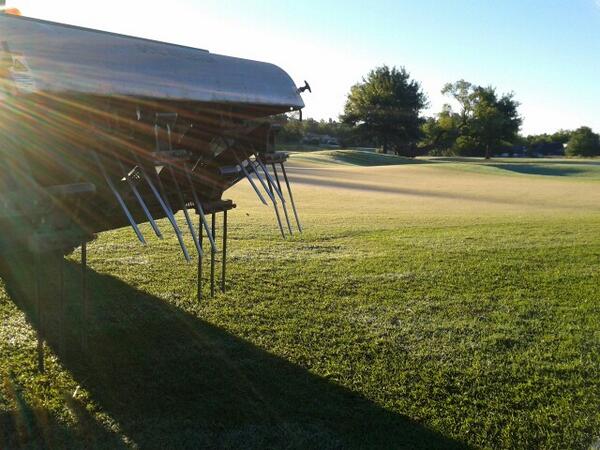
Embedded image permalinkLast week, the grounds staff began deep-tining greens.  The front nine greens and the practice facility were completed last week, leaving the back nine greens to be completed this week.  A solid, 1/2" by 10" tine is used for this process to create deep channels filled with sand to promote long, healthy roots going into late fall.  This time of year, as the days get shorter and the weather gets colder, the Bentgrass begins spending less of it's energy growing leaves and more of it's energy creating roots.  We want to take advantage of this process by allowing clear pathways for those roots to grow.  These holes, once created, are carefully filled with sand to ensure optimum water movement from the surface down to the drainage pipe underneath the root zone.  

The grounds department realizes that this process is being performed merely a month after our September aeration, and the inconvenience that is caused not only by the process, but by the subsequent recovery.  However, we feel that the long-term benefits that will be realized through this process far outweigh the temporary disruption in playing conditions.  Rest assured that the staff will work diligently to get the putting surfaces back to normal as quickly as possible and we appreciate your patience as the greens recover.

As always, if you have any questions, feel free to post them here, or contact the grounds department.  Thank you.