Thursday, April 23, 2015

What's Going On With Our Fairways?

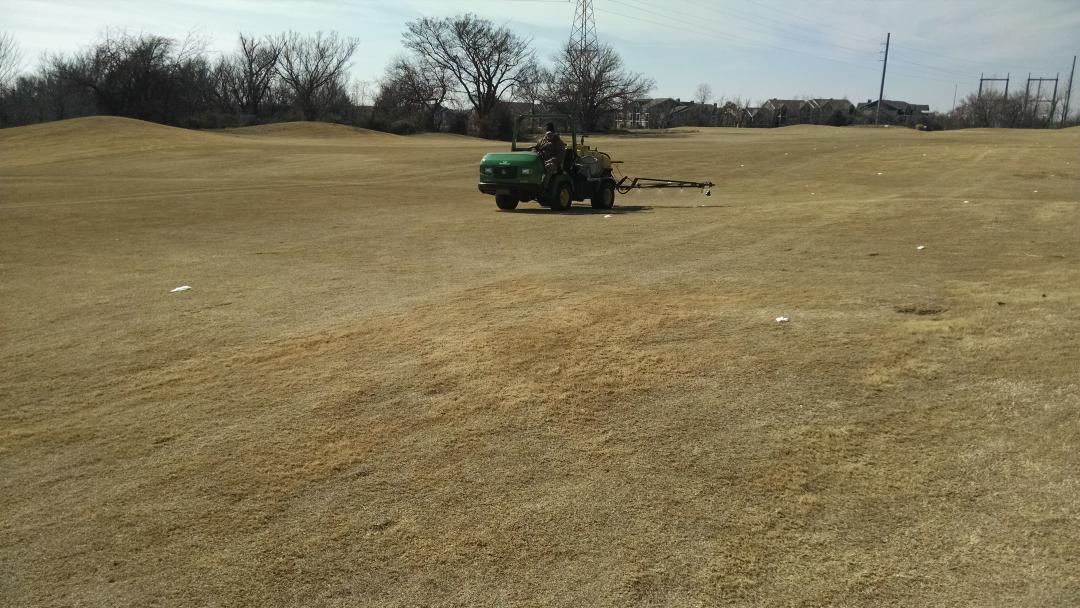
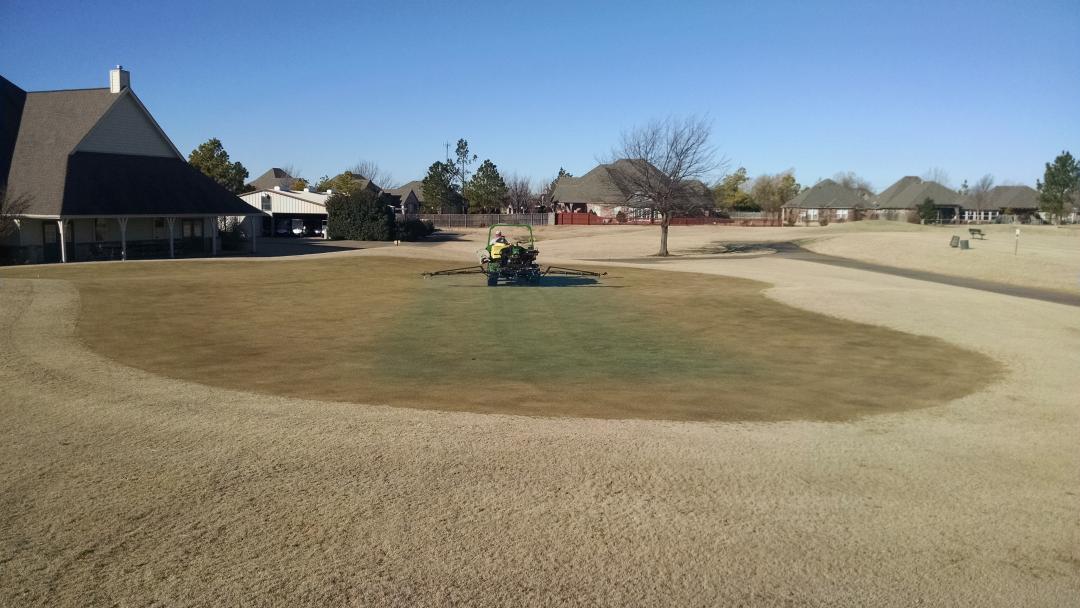
This image shows unaffected strains of Bermuda amongst the more
susceptible strains throughout the fairway.
Some of you who've played the golf course within the past few weeks might be wondering what is going on with our fairways.  As you can see from the picture above, much of the Bermuda in the fairway is thin and is not filling in very well, while other portions of the fairways seem to be doing fine.  While there are several factors that have caused the fairways to look like this, a fungal disease has stuck out as the leading cause for the damage.

Affected leaves are discolored and weak,
eventually dying back to the base of the
plant
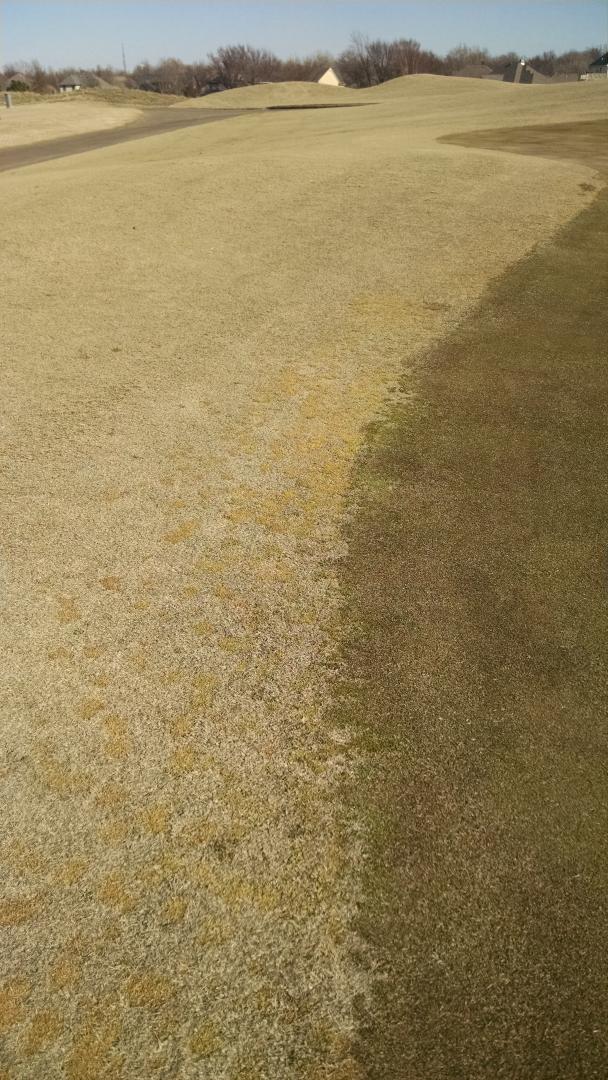
April is always a time of transition, usually the Bermuda begins to wake up around the first of the month and then spends the rest of the month filling in until the grass achieves full density by May 1st.  The grass can appear patchy and uneven during this time and little thought was given to the look of the course.  By all accounts, we felt the course was greening up as expected.  However, the weather in April thus far, has not cooperated and has been unfavorable to the Bermuda.  According to the National Weather Service in Tulsa, since April 1st, we've only had 2 days without any cloud cover and 50% of the month has been under complete cloud cover.  During that same time, it rained 14 days out of the 23 days thus far in April for a total of 3.26".  This combination of constant cloud cover and excessive soil moisture has left the Bermuda on the golf course very susceptible to disease.  Around April 14th, we started to notice that the fairways were not filling in like we'd expected and that something was wrong.  We were puzzled that the fairway would be affected but not the adjacent rough.  I began to suspect winter injury because the rough height Bermuda is much taller than the fairway and therefore more cold tolerant.  However, after closer inspection, I realized the lesions (fungal infections) on the leaves and realized we have a fungus called Leaf Spot.  Leaf spot is also called Melting Out, due to the visual symptom left behind of the grass loosing density and seemingly melting down into the soil.  Leaf spot is very common on susceptible Bermudagrasses such as the type that make up the majority of our fairways.  Especially during a wet, cool, cloudy spring while the plant is trying to wake up from dormancy.  All the fungus needs is an entry point, which we unwittingly provide every time we mow.  It seems that the mowing equipment has also spread the disease throughout the fairways.  This could explain why the rough is unaffected, since we haven't mowed fairways yet.  It also explains why some areas of Bermuda seem unaffected next to severely affected areas.  This is due to our fairways containing various types of Bermudagrasses and their genetic tolerances to various pests.  Some Bermuda strains are simply more tolerant to Leaf spot than others.

This image shows the after affects
of Melting Out disease
So what do we do about it?  We cannot control the weather, so we must be patient until the warmer, drier weather begins.  This will naturally turn the advantage back to the Bermuda and the grass should recover quickly.  There are several chemical options that could be used, but we do not have a budget for fungicides on fairways (25 acres).  Since we'd be looking at almost $3,000 for just one treatment, we must be objective and decide if the cost is worth the benefits.  Next week, we have a previously planned course wide fertilizer application scheduled.  This fertilizer coupled with some warm, sunny weather could potentially do more for our fairways than a fungicide application.  It will all depend on the weather.  If we continue to have this kind of weather, we may not have a choice but to remove the disease pressure using fungicides.

Please be assured that the grounds staff is monitoring the issue closely and that every step will be taken so that the course can be in the best condition as possible.  If you have any questions regarding the fairways, or any other issue at the course, please feel free to contact us.  Thank you.


Wednesday, April 22, 2015

More drainage work....

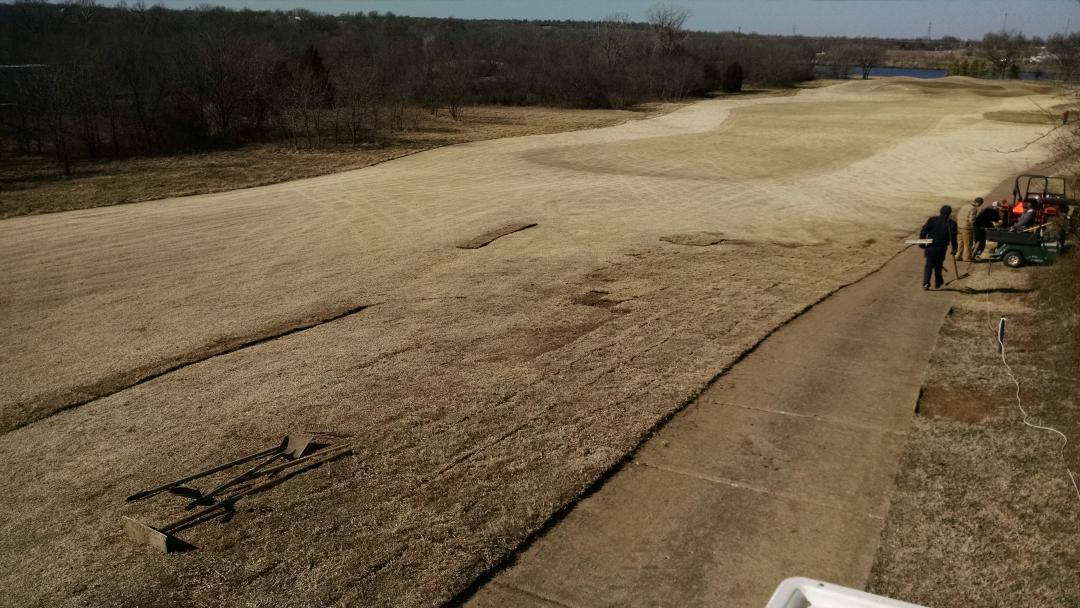
Drainage water had collected at bottom of green and found exit point in approach

On Monday, the grounds staff began work on a drainage issue in front of #14 green in the middle of the approach.  The drainage system underneath #14 green exits to the southwest through the approach and goes downhill towards the cart path.  We recently discovered a persistent wet spot right in the middle of the approach, and knowing the drainage is in the vicinity, knew we needed to at least take a look to see what's going on.  The staff dug up the wet spot and found a pocket of saturated greens mix but no pipe.  This spot is about ten feet left of where the drainage system is located.  This means that some of the water inside the green cannot quite make it to the pipe and has collected in a second low spot to the left.  Once enough water collects there, the water "tops" over the clay edge into the sand layer above.  The water then moves inside the sand until it can surface through the turf.  This is where the wet spot came from in the approach.  Our solutions was to create a drainage extension to give the water in that second low area somewhere to go so it will stay underground.  This should keep the turf in the approach from getting saturated.  Although we had a tournament on Monday afternoon and another one Tuesday morning, the staff did a great job getting this project completed as soon as they could.  The area is all put back together and we apologize for any inconvenience this project may have caused.


Pipe extension w/ green left of picture 
Beginning of drain extension w/ fabric to keep sand out of pipe


.
New drain pipe ties into existing drainage on east side of approach

Thursday, April 16, 2015

Ugly Putting Green

If you've been on the putting green lately you've likely noticed the blotchy yellow color throughout the green.  This is annual bluegrass, or Poa annua, that has been treated with a growth regulator as part a control program aimed at reducing the Poa annua contamination in our greens.  Generally, as greens age, contamination from Poa  becomes more prevalent.  This is especially true on greens that receive heavy foot traffic and have a history of excessive soil moisture.  Poa tends to grow faster than Bentgrass throughout the day and therefore greens with excessive amounts of Poa will get bumpy and slow as the day progresses.  This chemical won't kill the Poa, it just stunts the growth and allows the Bentgrass to better compete for water and nutrients.  I realize this green doesn't look very good during this process, but hopefully, an increase in putting quality will make up for it.

As summer approaches, we will back off the chemical control and let the summer heat continue to discourage the Poa.  Then, when fall approaches and the temperatures cool off, we'll start up the program again.  Antagonizing the Poa throughout the growing season, is our best defense until other control options are developed.  If you have any questions regarding our Poa control program, please feel free to ask.  Thanks

The yellow Poa plants really stand out against the dark green Bentgrass

This lower tier closest to the clubhouse has the most Poa

Friday, April 10, 2015

Drain Work at #12 Green


Please excuse the mess on the right side of #12 green as you play through this weekend.  It was discovered a few days ago that the drainage coming out of #12 green was plugged up.  Staff will be replacing the plugged drain line today and should have the area leveled off before the end of the day.  However, the work site will not be sodded before the weekend.  Ground under repair markings are in place to clarify the work site.  Please use caution when retrieving golf balls within the area.  Thank you for your patience while our staff works in this area.

Tuesday, March 31, 2015

Spring Fairway Slicing

It's that time of year again!  Time to loosen up the soil and encourage new growth on our short turf.  This week, the grounds staff is using our shatter tine machine on fairways.  This machine does a great job improving drainage, oxygen content and loosening up the soil.  The tines are solid and do not remove any soil, but are curved and so they "shatter" the soil as they go in and come back out.  Once the fairway has been sliced, the fairway mower and tractor blower do a great job cleaning them up.  Below is a video showing the debris that is removed from the process.  After the process is done, the slit left behind is very minimal with almost no disruption to the surface.  The soil should continue to warm up quickly due the the increase in warm air in the tine holes.  This will encourage a quicker green up of the Bermuda.  Next week, the grounds staff will repeat the process on the tee boxes.

Monday, March 30, 2015

Landscape Bed Work

After setting up the golf course for the first Owasso High School tournament this morning, the staff kept off the golf course and spent some much needed time working in the landscape beds at the clubhouse.  The one bed that needed the most work was the landscape bed at the northeast corner of the building between the F&B area and the putting green.  This bed has always been an issue due to it's Northeast exposure and poor drainage.  Before the staff planted a whole bunch of new shrubs, we took the time to address some of these issues.  First, a new drain pipe was installed to take the downspout water underground to the east and it exits near the cart path.  This will reduce the amount of water in the bed and should allow us to maintain drier conditions.  The northeast exposure means that there is very little direct sunlight on this bed and any moisture in the soil takes much longer to evaporate that other beds around the building.  This slow dry time, coupled with the excess water coming off the roof effectively drowned the plants that were there.  Now that the drainage issues have been resolved, new shade tolerant plants have been added.  Slow release organic fertilizer and mulch were then added to finish the project.  The staff did an amazing job getting this done in such a short amount of time.  The beds on either side of the F&B entrance are next on the list.  More soil needs to be added and the plants replaced.  We should have all the landscaping done by the end of the week.


Friday, March 20, 2015

#9 Greenside Bunker

This past Thursday, the crew took the left over sand from greens aeration and filled the two greenside bunkers on #9.  The sand depth in these two bunkers had become too shallow and the risk of contamination had become too great to ignore.  Approximately 10 tons of sand was added to the two greenside bunkers.  The fresh sand made an instant impact on the aesthetics and playability of these bunkers.  The grounds staff did a great job getting this project done in such a short period of time.

Depths are checked and sand is added to create consistent depth throughout the entire bunker


Playability and aesthetics are greatly improved by adding the new sand!

Spring Greens Aeration

The weather and fertilizer perked the greens up quickly
Pulling a lot of thatch out of the putting surface!
  Earlier this week, the grounds staff completed our spring greens aeration.  This is always a busy few days for the crew and this year they did an amazing job getting all the work done on schedule.  The weather leading up to aeration improved and allowed the greens to wake up just in time for the process.  One week before we were scheduled to start punching holes on the front nine, Doug, our chemical technician, applied some granular fertilizer to the greens to help wake them up from dormancy and get them growing.  We time the fertilizer to kick in just as we start the project so that a quicker recovery is encouraged and the greens will be back to normal as quickly as possible.  The weather post aeration is also very important to how long the recovery takes.  The weather has been ideal, with several rain showers, sunny days and mild nights.  It seems we are right on schedule for our usual 1-2 week recovery window.

Most golfers deal with the after affects of aeration on putting greens, but few know exactly how it is performed and why we must go through the process.  While there are many ways to perform core aeration, this is the process that works for us.  First, the greens are "verticut" with our greens mower two times at perpendicular directions.  This creates little square grooves for sand to settle into.  More information about verticutting can be found here.  Then we mow the greens to clean up the longer leaves that are left behind the verticutter.  Once the green has been mowed, the aerator pulls the cores out of the green and pulls them to the collar for removal.  As you can see from the picture on the right, the aerator removes a large amount of soil.  This sand based soil contains built up organic matter that can create wet, soft conditions and harbor disease.  Removing this material, and replacing it with straight sand allows us to maintain drier, firmer, healthier putting surfaces.  After the cores are all cleaned off, the greens are then blown completely clean so the holes are all open and ready for sand.  The next step is to topdress the greens with a very specific amount of USGA topdressing sand.  This sand has a very specific particle size that is compatible with the sand found in our greens profile.  This sand is allowed to dry completely and then is drug into the holes using a drag mat towed behind a utility vehicle.
Sand is heavily applied and left to dry before dragging into holes
Once the sand is worked into the holes, the greens are rolled to smooth out any depressions from tire tracks or footprints.  The greens are drug once again to be sure to incorporate as much sand into the holes as possible.  Water is then applied to settle the sand into the holes and keep the grass from stressing out from all the aggressive cultural practices.

The greens are then left to rest for a few days so the grass can begin to fill into the holes we made and allow the sand at the surface to integrate into the canopy.  Today, the staff spent some time rolling, dragging and mowing the greens to get them as good as possible for the weekend.  Over the next week, the greens will seem less sandy and the turf growth integrates the sand into the canopy and normal putting conditions return.  We appreciate everyone's patience during this time.
 

Monday, March 2, 2015

February Course Update


Embedded image permalink

The weather started off mild and the grounds staff was in high gear working on our winter project list. We began spraying our course wide pre-emergent, continued sodding bare areas along cart paths, and topdressing divots on the driving range tee box.  The staff was busy preparing our equipment to begin our annual tree maintenance work, when the course received over 4 inches of snow on Sunday the 15th.
Embedded image permalinkThe snow halted all progress on the golf course and forced the staff to stay in the shop.  Since we couldn't get onto the golf course, the staff got to work on some shop projects to keep busy.  The staff built bird houses, wash racks, and tee markers.  They striped the floor in the equipment bay to create safe walkways, and designate where machinery should be stored.  Dan, our equipment manager, began working on all the equipment that will be needed for our March greens aeration.
Embedded image permalink

During the last week of February, Michael, our assistant superintendent and I, went to the Golf Industry Show.  This conference is hosted by our national golf course superintendent association.  Each year superintendents and other golf industry professionals come together to network, attend educational seminars, and walk the trade show to mingle with colleagues and learn about the latest equipment and supplies we need to improve our golf maintenance operations.  Each year, when I return from this trip, I am invigorated to start the golf season and give the members and guests of Bailey Ranch the best golf experience possible.
Embedded image permalink

It seems the winter weather will stick around for another week or so, then we should start to experience some milder, spring-like, weather.  Spring is just around the corner and the grounds staff will begin ramping up their agronomy programs once we warm up.  Our spring greens aeration is scheduled for March 16th and 17th.  Once we get that process done, we should be into warmer days and the beginning of the 2015 golf season!  


Embedded image permalink

Embedded image permalink

Tuesday, February 17, 2015

Snow

#16 looking back toward the tee
Embedded image permalink
#18 fairway is a popular place right now
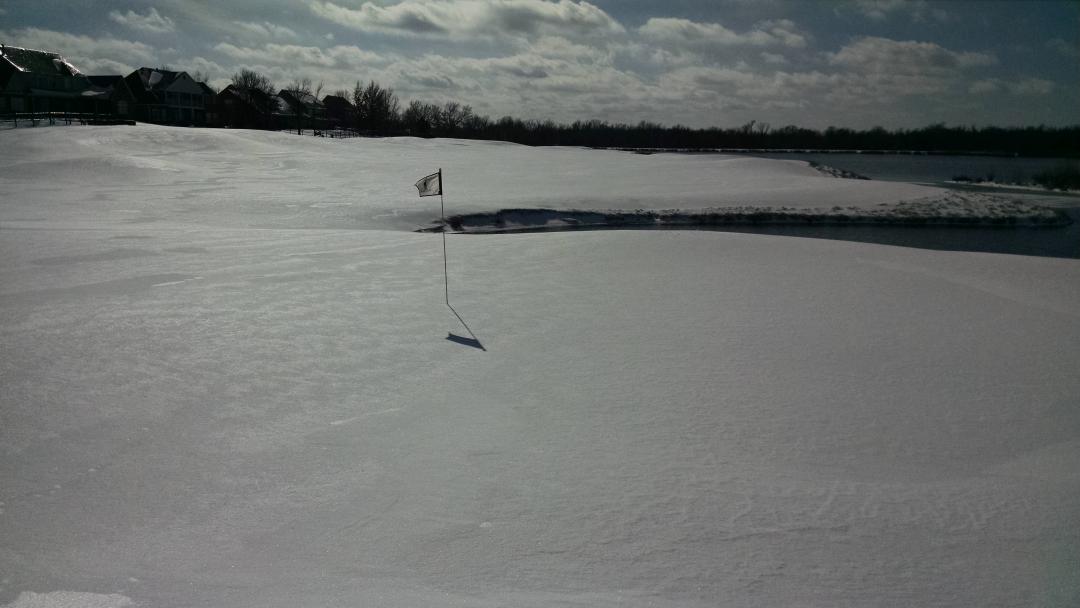
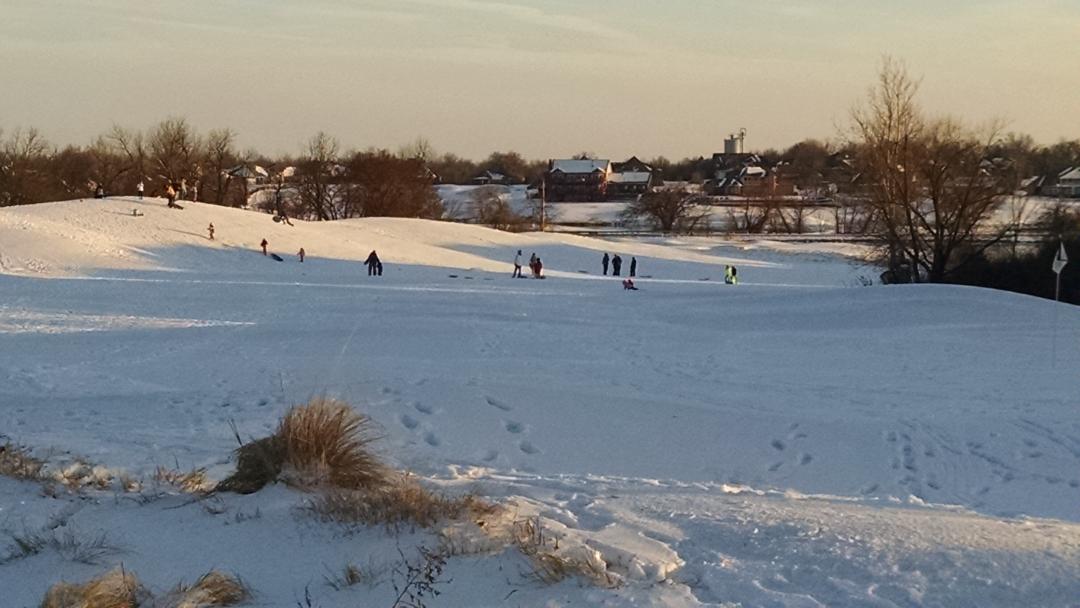
On Sunday night, the golf course got it's first measurable snow event of the season.  February is usually the month we get some snow and once again it didn't disappoint.  Staff came in on Monday and started clearing sidewalks and doorways around the clubhouse.  Otherwise, we're staying inside working on several projects to keep us busy.  Currently, the only activity happening on the golf course right now is sledding on #18 fairway!

The sun came out yesterday afternoon and I took a short walk to capture a few pictures of #16 and #17 in the snow.  We don't get a lot of chances to see the course covered in snow so I had to take advantage.

#17 looking toward green

#11 fairway looking toward #17 tee

Monday, February 9, 2015

#15 sod work

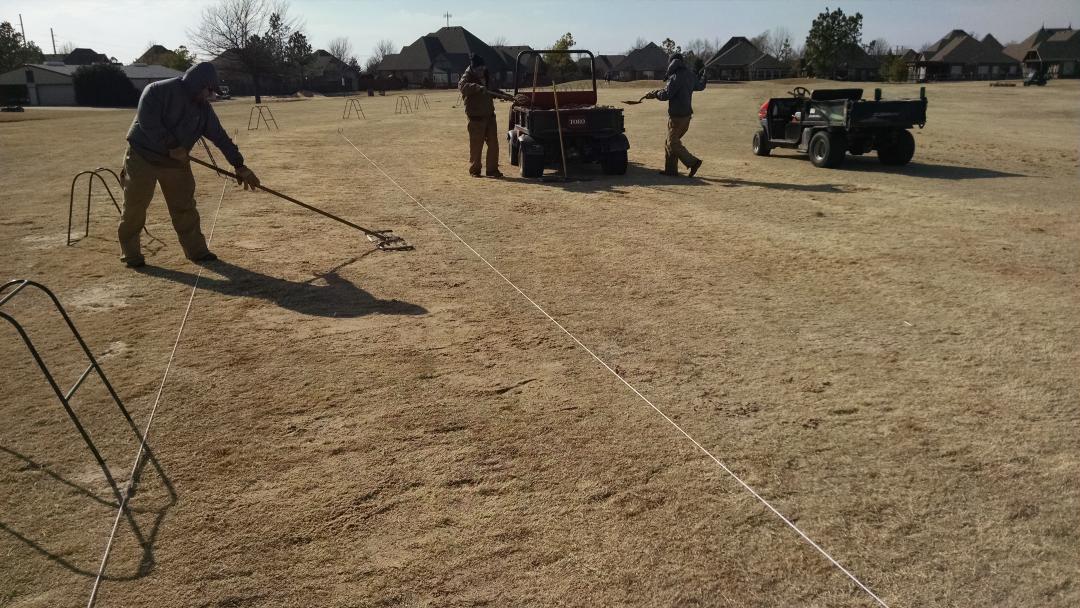
Late last week, the grounds staff used some left over sod to fix a washed out area along the cart path on #15.  This spot is on the north facing slope just after #15 forward tee as you go downhill toward the fairway.  The turf in this area came out of winter last year thin, which allowed the soil to erode during the rainy season.  The erosion left a sizable rut down the edge of the cart path.  The picture to the right shows the area in question after six loads of soil had been added and leveled.  Sod was then added and stapled down to keep it in place until the sod has a chance to root into the ground.  The area will be roped off until spring green-up.  Please keep off the sod until the ropes come down so we can ensure a successful grow-in.  


Wednesday, February 4, 2015

January Course Update

Embedded image permalinkThe weather during January can be unpredictable to say the least.  Cold weather is expected but there can be plenty of great weather as well.  This year was no different. We started out January with seasonably cold weather which kept golfers away.  Thankfully, during the second half of the month, the weather warmed up to record levels which allowed many of the members and guests to enjoy some great golf.  The warm, dry weather exacerbated the already strengthening drought conditions which forced the grounds staff to apply a wetting agent to greens to keep soil moisture at acceptable levels.  We don't typically need to do this, but felt it was necessary to intervene.

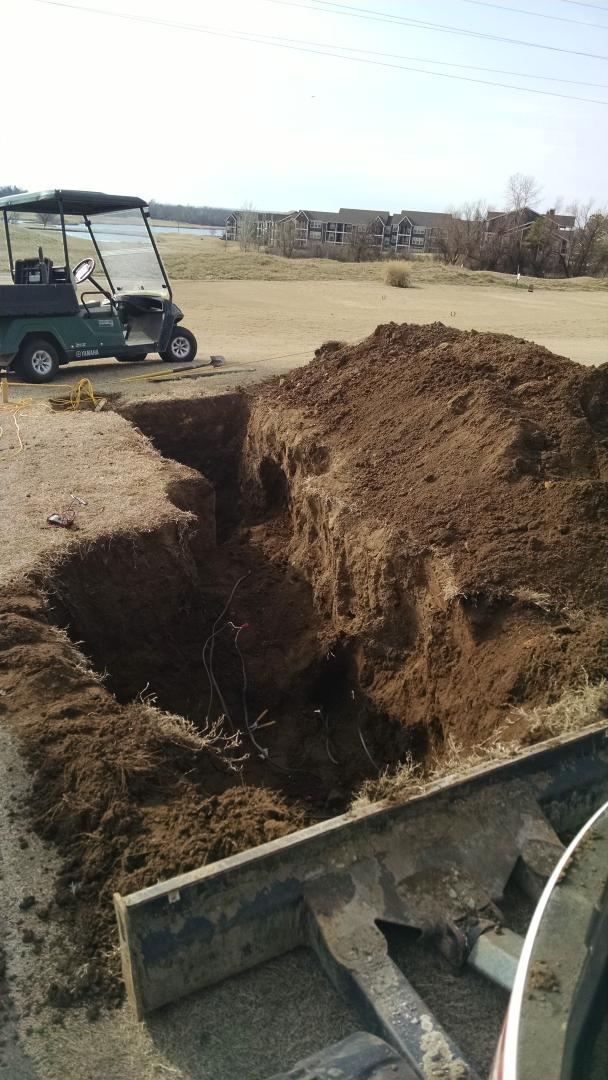
Embedded image permalinkThe nice weather was not only great for golfers, the grounds staff took advantage of the mild weather and got several key projects completed.  During the middle of January, Doug, our chemical technician, applied a generic Roundup product to our greens surrounds to clean up the few weeds we have.  We are now seeing the effects from that spray and am excited to see the surrounds cleaned up.  Those of you who played during mid-January, likely noticed the large hole near #1 tee.  Joe, our irrigation technician, had been dealing with an bad electrical splice that powered our irrigation system on holes 1,2,10, and 18.  It was a big relief to have that problem solved and the hole backfilled.  The big project we worked on, was the drainage addition to #7.  I spoke in detail about the project in our last post, so I won't expand on that here.  However, that was a big project that took our entire crew several weeks. 
As we phase into February, wrapping up winter projects and preparing for spring will be our main focus.  Continued drainage work, tree pruning, and preemergent applications will be at the top of our list.  The golf course seems to have made it through January in great condition.  Barring any serious weather in February, I feel very confident about where the golf course is positioned as we near late winter.  

Embedded image permalink


Friday, January 30, 2015

#7 Drainage


Over the past week or so, the grounds staff had been working on a drainage project along the cart path of #7.  This project has been on our wish list for some time and are glad to have it completed.  The drainage system for the #7 green, bunker and basins around the green, all connect together and go north to an exit point about 150 yards away from the green.  When the course was constructed, and no houses existed, this likely seemed to be the best option.  Years later, with the area fully developed, this drainage outlet has been a nuisance for the homeowners in the area.  To solve the problem, it was decided that the best thing to do would be to take the drain outlet down to the ditch right of the tee complex near Mingo, by adding additional drainage pipe.  In total, staff added almost 800' of drain pipe and had to cross the cart path twice.  This presented the only real challenge to the project, in that we had to cut and remove portions of the cart path so we could trench in new pipe.  Once the new pipe was installed, new concrete was installed back to repair the cart path.  Earlier this week, the last few details were completed and the project is now officially done.


Tuesday, December 30, 2014

Weather Update & Look Back at 2014

I've shared the most recent forecast for the upcoming winter weather courtesy of the Gary McManus, Oklahoma's Climatologist for the Oklahoma Climatological Survey.  It's a funny take on recent weather events as well as a thorough look back at the weather we experienced this past year.  Enjoy!


MESONET TICKER ... MESONET TICKER ... MESONET TICKER ... MESONET TICKER ...
December 29, 2014  December 29, 2014  December 29, 2014  December 29, 2014 


The excitingly boring weather of 2014

It's hard to look past the coming arctic blast to end 2014 to look BACK at the
past weather of 2014, so let's get the future excitement out of the way first.
Okay, to start off with, since freezing rain has mentioned, we are officially
moving the BRAUM'S BREAD-AND-MILK DEFCON LEVEL to THREE!!! I repeat, we are
officially moving the BRAUM'S BREAD-AND-MILK DEFCON LEVEL to TWO!! (see how
quickly we react here with up-to-the-minute hysteria??)

http://ticker.mesonet.org/archive/20141229/braums-defcon2.png

Yes, we've gone to "KNOCK PEOPLE OVER IF YOU HAVE TO" level. Mostly bombastic
and reactionary, of course, but just our effort to try and keep folks from
driving on ice (DISCLAIMER: should ice occur).

Here is the setup as provided in pictures from the local NWS offices.

http://ticker.mesonet.org/archive/20141229/nws-amarillo.jpg
http://ticker.mesonet.org/archive/20141229/nws-norman1.jpg
http://ticker.mesonet.org/archive/20141229/nws-norman3.jpg
http://ticker.mesonet.org/archive/20141229/nws-norman4.jpg
http://ticker.mesonet.org/archive/20141229/nws-norman5.jpg
http://ticker.mesonet.org/archive/20141229/nws-norman6.jpg
http://ticker.mesonet.org/archive/20141229/nws-tulsa.png

Remember, this is winter weather we're talking, so the forecast is going to
change between now and ICE-MAGEDDON. So keep track of the changing conditions
as we get closer because the precipitation type is vitally important. However,
the arctic blast is a certainty.

The beast is poised to our north as we speak.

http://ticker.mesonet.org/archive/20141229/us-windchills.png

So prepare for this, because it's coming.

http://ticker.mesonet.org/archive/20141229/wed-morning-lows.png

I'm afraid there won't be any melting on the roads with this coming system.

Okay, enough hysteria. Let's turn back the clock and take a look back at 2014.

Enjoy.
-------------------------------------------------------------------------------


The weather of 2014 would probably be considered boring by most, and rightfully
so. After all, there were no EF-5 twisters ravaging the countryside, nor was
there a never ending onslaught of days with triple-digit heat. The blizzards
of the last few years never materialized, nor did that other unwelcome winter
visitor, the ice storm. What we did have, however, was drought, the most boring
– if not most damaging – of Oklahoma's weather hazards. That particular guest
has been plaguing Oklahoma's ecosystem, agriculture and economy since its
beginning in late fall 2010 to the tune of several billion dollars in damage.
The spring rainy season was mostly a bust, although a return of moisture in
late May paved the way for more rain during June and July. That
uncharacteristically timed relief delayed the re-intensification of drought
that started earlier in the year, but more dry stretches from August forward
left over 60 percent of the state in drought at year's end. The year ended with
a dark, dank and dreary December in which the sun was mostly a no-show at only
35.4 percent of possible sunshine according to the Oklahoma Mesonet's solar
radiation sensors.

In the end, 2014 left us with memories of a (mostly) cold and (mostly) dry
year, with a few bursts of excitement to satisfy most weather enthusiasts. Here
are a few or the more notable weather highlights (or lowlights) from 2014, as
well as the top extremes as measured by the Oklahoma Mesonet.

2104 Oklahoma Weather Highlights
• According to preliminary data from the National Weather Service (NWS), 2014
  ended up with a total of 16 tornadoes, the lowest count since accurate
  records began in 1950. That bests the previous minimum annual twister count
  of 17 back in 1988. That stands in stark contrast to recent years that ranked
  near the top for annual tornado totals. The record of 145 is still held by
  1999, but 2011 and 2010 rank with the second- and fourth-highest totals at
  119 and 103, respectively. And 2013 tied for ninth highest at 82. The annual
  average tornado total for Oklahoma is approximately 56.
   o The strongest 2014 tornado listed was an EF-2 that struck the small
     town of Quapaw in Ottawa County, killing one and heavily damaging as
     many as 50 structures.
   o A tornado touched down near Lake Arcadia in central Oklahoma on the
     December 14, only the 25th tornado since 1950 for that month.
   o Of the 16 confirmed tornadoes, 11 were of the weakest rating of EF-0.
   o Although not associated with a tornado, a thunderstorm near Burneyville
     on July 30th produced a wind gust of 106 mph, tied for the fourth highest
     in Mesonet history.

• According to preliminary data from the Oklahoma Mesonet through December 28,
  the statewide average precipitation total for the year thus far was 28.56
  inches, 7.74 inches below normal. Depending on what possible precipitation
  falls in year's final three days, it is estimated that 2014 will rank
  somewhere from 25th to 30th driest since 1895 (note: the rankings in the
  statistics table below are since 1921).

   o The Mesonet site at Kenton recorded 13.2 inches of precipitation during
     2014, the lowest such total in the state. Broken Bow and Clayton led the
     state with 50.8 inches each.

http://ticker.mesonet.org/archive/20141229/2014-total-precip.png
http://ticker.mesonet.org/archive/20141229/2014-depart-normal-precip.png
http://ticker.mesonet.org/archive/20141229/2014-precip-stats.png


   o The spring (March-May) rainy season was the 11th driest on record with a
     statewide average of 6.57 inches, more than 5 inches below normal.

http://ticker.mesonet.org/archive/20141229/mar-may-totals.png
http://ticker.mesonet.org/archive/20141229/mar-may-depart-normal.png
http://ticker.mesonet.org/archive/20141229/mar-may-pct-normal.png

   o The January-May statewide average was 7.39 inches, the 3rd driest first
     five months of the year on record.
   o June and July combined were the 15th wettest on record across Oklahoma
     with an average of 10.28 inches, nearly 3.5 inches above normal.

http://ticker.mesonet.org/archive/20141229/jun-july-depart-normal.png
http://ticker.mesonet.org/archive/20141229/jun-july-pct-normal.png
http://ticker.mesonet.org/archive/20141229/jun-july-totals.png

• A no-show summer and a frigid first few months of the year guaranteed a cool
  2014, and the statistics back that up. Preliminary data from the Oklahoma
  Mesonet place the statewide average temperature for 2014 at 58.9 degrees,
  about a degree below normal. Depending on what occurs the last few days of
  the year, that would rank 2014's temperature somewhere in the 20-30th coolest
  on record range. Interestingly, 2013's final statewide temperature also
  finished at 58.9 degrees.
   o Summer itself was the 24th coolest on record with a statewide average of
     78.6 degrees, 1.1 degrees below normal.
   o July was the fifth coolest on record and 4.3 degrees below normal.
   o A brush with frigid weather in the middle of November proved to be one of
     the most significant early-season winter outbreaks on record for Oklahoma.
     The cold snap began with a cold front on the 11th that dropped
     temperatures from the 70s and 80s into the 30s and 40s. The Oklahoma
     Mesonet station at Boise City struggled to a high of 15 degrees on the
     12th just two days after reaching a high of 81 degrees. Most of the state
     had spent from 100 to more than 150 hours below freezing. The event also
     came with a statewide blanket of snow. Amounts of 3-4 inches were common
     across parts of western, northern and central Oklahoma.
   o December finished the year off with one last warm month, but not in the
     way one would normally think. There were very few pleasantly warm
     afternoons, as daytime highs were actually a bit below normal. The morning
     lows, however, were another story. Through the 29th, the statewide average
     low temperature was 35.2 degrees, 7.7 degrees above normal. Overall, the
     statewide average through the 29th was 3.4 degrees above normal. The last
     two days of December promised to be quite chilly, however, which could
     bring that average down just a bit.
-------------------------------------------------------------------------------

The 2014 Oklahoma Mesonet extremes


----------------------------------
Temperature
----------------------------------
Maximum Air Temperature
FREEDOM  106.9 F  07/26/2014

Minimum Air Temperature
NOWATA   -12.1 F   01/06/2014

Maximum Heat Index
LANE     112.6 F   08/08/2014

Minimum Wind Chill
ALVA     -25.0 F   01/06/2014

Greatest 1-hour Temperature Change
KENTON   32.9 F   (80.6 F 11/10/2014 21:55 to 47.7 F 11/10/2014 22:50)

Greatest 24-hour Temperature Change
SLAPOUT  66.2 F   (84.6 F 11/10/2014 20:40 to 18.3 F 11/11/2014 13:15)


----------------------------------
Humidity
----------------------------------
Highest Dew Point Temperature
BROKEN BOW   81.3 F   07/27/2014

Lowest Dew Point Temperature
MIAMI   -18.8 F   01/06/2014


----------------------------------
Rainfall
----------------------------------
Greatest 1-hour Rainfall
HINTON  3.07"   06/19/2014

Greatest 24-hour Rainfall
CLAYTON   6.60" (07/30/2014 - 07/31/2014)

----------------------------------
Wind Speed
----------------------------------
Maximum Wind Speed (5-minute average)
BEAVER   59.7 mph   07/01/2014

Maximum Wind Gust
BURNEYVILLE    105.8 mph   07/31/2014


----------------------------------
Pressure
----------------------------------
Highest Mean Sea Level Pressure
CHEROKEE   1044.55 mb   01/23/2014

Lowest Mean Sea Level Pressure
MAY RANCH   989.17 mb   04/27/2014

Gary McManus
State Climatologist
Oklahoma Mesonet
Oklahoma Climatological Survey
(405) 325-2253
gmcmanus@mesonet.org

Sunday, December 28, 2014

New Equipment

It's not a secret that mowing equipment is an indispensable asset to any golf course.  Mowing is the one job that is done most frequently and has the biggest impact on the condition of the golf course.  From the first moment I saw our mowing fleet back in 2007, I quickly realized that a plan would be needed to phase out some of this old equipment to improve productivity and course conditions.  Over the years, we've had some success replacing certain machines, but never really made a big dent in the problem due to budget constraints.  We determined, that due to the condition of our old fleet, we wouldn't ever realize the increases in efficiency and course conditions if we just picked at the problem by buying 1-2 machines a year.  Keeping all this in mind, the grounds staff determined that leasing to purchase the entire fleet in one package would be most cost effective option.  The staff demoed equipment over the past year to determine which equipment would meet our needs.  Through this process, we quickly realized just how much inefficient our old fleet really was.

On November 18th, 2014, a recommendation for approval of a lease agreement was presented to the Owasso City Council.  The council, after some thorough questioning, unanimously approved the agreement.  I'd like to take a minute to recognize the council, as well as the leadership at Owasso City Hall.  The administrative staff at the City has been extremely supportive throughout this process.  I left that council meeting humbled by the strong vote of confidence by the Owasso City Council, thereby affirming their support for everything that the Bailey grounds department has done over the past several years to get the golf course back into something the community can be proud of.

This past week, the Bailey Ranch Grounds Department took delivery of the new fleet.  After years of struggling to keep the old equipment running, words cannot describe how grateful we are to have this new equipment!  The grounds staff will do everything in their power to ensure this equipment remains the best possible condition.

With all this new equipment sitting ready to go, we cannot wait to get started on a great 2015 seaon!


Friday, December 5, 2014

Divot Pattern Reminder

Now that the Bermudagrass on the driving range is fully dormant, the divot pattern used by golfers will become increasingly important due to the lack of recovery by the turf.  Typically, the Bermudagrass will not grow aggressively enough for quick recovery from divots until late April.   This fairly long dormancy period, coupled with the intermittent mild weather we experience, can leave the quality of the driving range tee in less than ideal condition.

As I've mentioned before, the divot pattern in the graphic to the right, is the preferred pattern all year long.  It allows for quicker recovery through the growing season and allows us to maximize the dormant turf throughout the off-season.

The grounds staff would ask that you please follow this simple technique to preserve as much grass as possible so that we can maintain the highest quality turf possible until the plant begin to recover in spring.